Parenting in the Age of AI: What Actually Matters Now
Editor’s Note: This article is an entry point into a broader framework we are developing on children, development, and AI.
It takes a deliberately non-hype, non-alarmist approach—focusing instead on how AI shapes thinking, learning, and development beneath the surface.
Rather than offering quick solutions, it aims to help parents see more clearly, so they can guide their children with awareness in a changing environment.
Parenting in the Age of AI
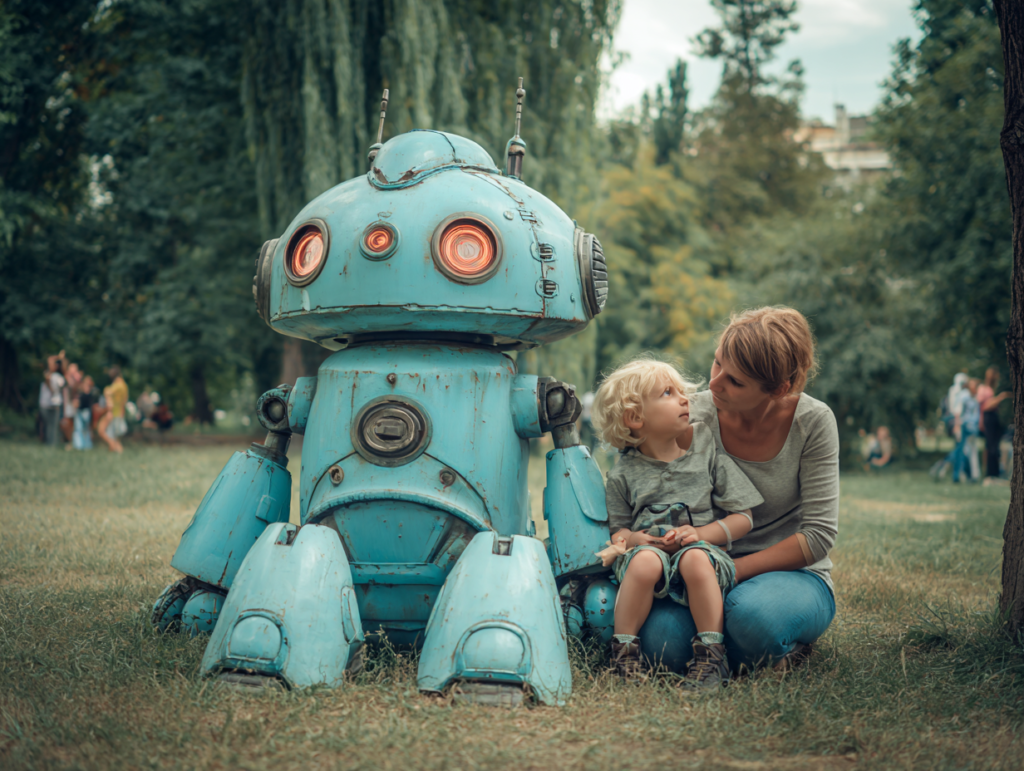
Children today are not simply growing up with new tools. They are growing up within a new kind of environment—one that thinks, responds, and adapts.
This is what makes parenting in the age of AI fundamentally different from previous generations.
In the past, technology mostly delivered information. Books, television, even the internet in its early form—these were channels. A child could receive content, but the structure of their thinking was still largely shaped elsewhere: through experience, relationships, and time.
AI changes this dynamic.
It does not just provide answers. It participates in the process of thinking itself. It responds instantly, adjusts to the user, and can feel—especially to a child—like a natural extension of their own mind.
As a result, children growing up with AI are not just learning faster or accessing more information. They are forming habits of attention, patterns of problem-solving, and even a sense of knowing in a different context.
This is why the conversation cannot stay at the level of:
- “Is AI good or bad for children?”
- “Should kids use tools like ChatGPT?”
These questions are understandable—but they are too narrow for what is actually happening.
The real shift is deeper.
The real question is not what children are using, but what kind of mental and psychological patterns are being shaped as they use it.
And once we begin to see it this way, parenting in the age of AI becomes less about controlling exposure—and more about understanding development.
AI Is Not a Tool — It’s an Environment
To understand what is changing, we need to let go of a familiar assumption:
We are used to thinking of technology as something we pick up and use—a device, an app, a platform. Something external. Something we can put down.
But AI does not behave like this.
It responds. It adapts. It learns from interaction. It mirrors language, completes thoughts, and often anticipates what comes next. For a child, this can feel less like using a tool and more like interacting with something that is part of their thinking process.
And this changes everything.
An environment is not something you occasionally use. It is something you are inside of. It shapes what feels normal, what feels easy, what feels possible.
Children growing up with AI are not stepping in and out of it. They are forming their habits of thinking within it.
There is an important lesson here—one we have already lived through.
During the rise of social media, many of the deeper effects were recognized only after they had already become normalized. By the time we began to seriously question attention fragmentation, comparison, and algorithmic influence, these patterns were already part of everyday life.
The problem was not just that social media had effects.
The problem was that those effects became the baseline before we fully understood them.
This time, the situation is different.
We are earlier in the process. The patterns are still forming. The norms are not yet fully fixed.
Which means something important:
We have a chance to understand what is happening while it is happening.
Not to control it completely—that is neither realistic nor necessary—but to see it clearly enough to guide children through it with awareness.
When we begin to view AI as an environment rather than a tool, a subtle shift happens.
The question is no longer:
- “How often should children use it?”
- “Which tools are safe?”
The question becomes:
What kind of thinking is being shaped inside this environment?
And once we ask that question, we naturally move toward something deeper than rules or restrictions.
We move toward understanding development itself.
What Is Actually Changing in Child Development

When we ask how AI affects children, it is easy to focus on visible behaviors:
- faster answers
- less effort
- more screen time
But these are surface-level observations.
What matters more is what is happening underneath—in the patterns that shape how a child thinks, focuses, and makes sense of the world.
Attention Is Being Rewired
AI reduces friction.
A question no longer needs to sit unanswered. Curiosity does not need to stretch over time. The gap between not knowing and knowing becomes almost invisible.
At first, this seems like a clear advantage.
But attention develops through tension—the small gap between a question and its answer. When that gap disappears, something subtle changes:
- patience becomes less necessary
- sustained focus becomes less practiced
- the ability to sit with uncertainty becomes less familiar
This does not mean attention is “getting worse.”
It means it is adapting to a different environment—one where immediacy is the norm.
Problem-Solving Is Becoming Externalized
In previous generations, problem-solving often required internal effort:
- trying
- failing
- reorganizing thoughts
- trying again
Now, many of these steps can be bypassed.
A child can move quickly from:
“I don’t understand this”
to:
“Here is a complete answer”
without fully experiencing the process in between.
Again, this is not simply negative. It is efficient.
But it raises an important developmental question:
If the process is skipped, what exactly is being strengthened?
The Relationship With Effort Is Shifting
Effort used to be tightly connected with progress.
Now, progress can sometimes appear without visible effort.
This can quietly reshape expectations:
- Why struggle if clarity can be generated instantly?
- Why persist if alternatives are always available?
Over time, this may influence how children relate to:
- difficulty
- frustration
- Mastery
Not by removing these experiences—but by making them easier to avoid.
Identity Is Forming in a New Context
Perhaps the most subtle shift is not about knowledge or attention, but about how children experience their own thinking.
Children are not only acquiring knowledge—they are developing a sense of where thinking happens:
- whether they attempt to work through a problem using their own mental effort
- whether they stay with uncertainty long enough to explore it
- whether understanding is built step by step
Over time, these repeated patterns shape something deeper than skill.
They shape internal capacity.
A child who regularly engages with problems internally begins to strengthen:
- persistence
- cognitive flexibility
- confidence in their own thinking
A child who consistently relies on immediate external answers may develop a different pattern:
- faster access to information
- but less experience in constructing understanding independently
This is not about right or wrong.
It is about what is being practiced.
When AI becomes a constant presence in the thinking process, it does not just provide answers. It can quietly influence where thinking is expected to happen—internally, externally, or somewhere in between.
And this influence is not dramatic or sudden.
It forms gradually, through repetition—through what the child does again and again, often without noticing.
A Different Kind of Question
All of this leads us away from simple conclusions.
It is not enough to say:
- this is good
- this is bad
Instead, we return to a more useful question:
What patterns of mind are being practiced, repeated, and strengthened?
Because development is not shaped by single moments.
It is shaped by what happens again and again.
The Wrong Questions Parents Are Asking
When a new technology appears, it is natural for parents to ask:
- “Is this good or bad for my child?”
- “How much should they use it?”
- “Should they be using tools like ChatGPT at all?”
These questions are understandable.
They come from a place of care and responsibility.
But they are also limited.
The problem is not that these questions are wrong.
The problem is that they are too small for what is actually happening.
They focus on usage—on how often, how long, how much.
But as we have seen, the deeper shift is not about usage alone.
It is about how patterns of thinking, attention, and understanding are being shaped over time.
A child can use AI rarely and still form habits of immediate resolution.
Another child can use it frequently and still engage deeply, reflect, and think independently.
So the issue is not simply whether AI is used.
It is how it is used—and more importantly, what it is replacing or reshaping in the process.
This is why the central question begins to change.
Instead of asking:
“Is AI good or bad for children?”
We begin to ask:
What is this environment encouraging my child to practice, again and again?
And from there, even more precise questions emerge:
- Is my child developing the ability to stay with a problem—or skipping directly to answers?
- Are they building understanding—or receiving it fully formed?
- Do they experience thinking as something they do, or something they access?
These are not always easy questions to answer.
But they are closer to the level where development actually happens.
Because children are not shaped by occasional use.
They are shaped by repetition—by what becomes normal.
When we shift the question in this way, parenting also begins to shift.
It moves away from simple control:
- limiting time
- blocking tools
And toward something more subtle:
- observing patterns
- guiding interaction
- understanding how the environment is influencing development
What Actually Matters (A Different Kind of Literacy)
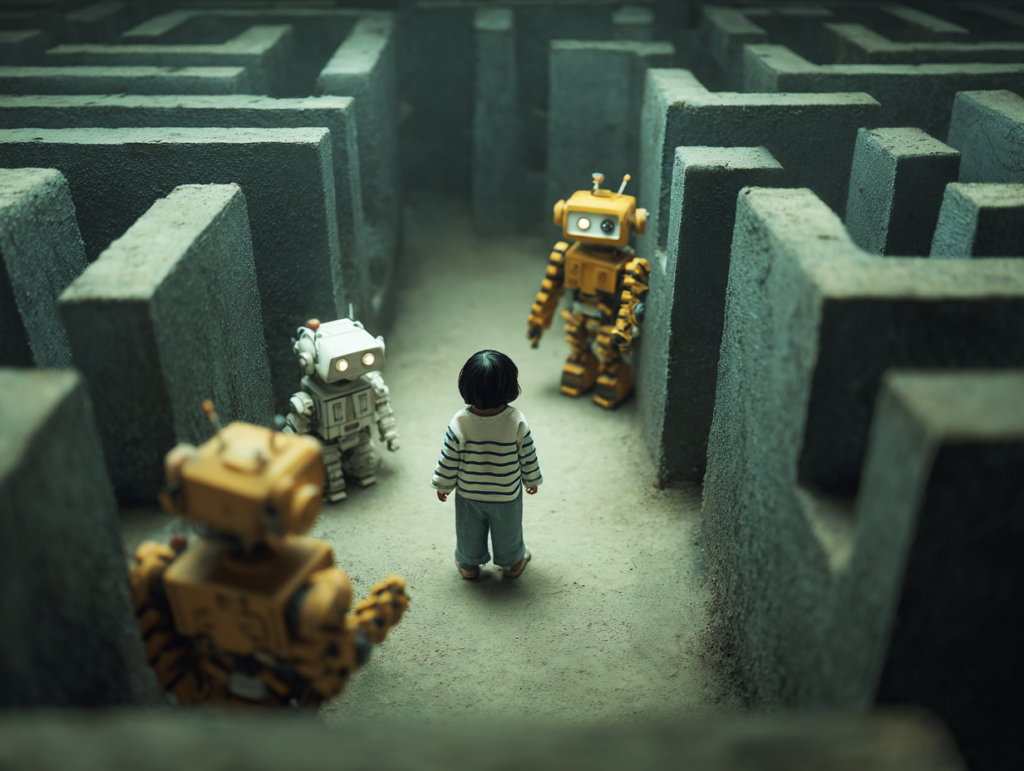
If AI is shaping how children think—not just what they know—then the question is no longer only about access or limitation.
It becomes a question of literacy.
But not only for children.
For parents.
AI Literacy Begins With Parents
Children can learn to use AI tools very quickly.
In many cases, faster than the adults around them.
They can ask questions, refine prompts, and receive clear, well-structured answers.
But this kind of fluency can be misleading.
Because using AI effectively does not mean understanding what it is doing—or how it is shaping thinking.
This is where the role of the parent becomes essential.
Not as a controller of tools, but as an interpreter of the environment.
Before children can develop meaningful AI literacy, parents need a basic awareness of what AI is—and what it is not.
Without this, guidance becomes difficult.
Because it is hard to guide something that is not clearly understood.
Psychological Literacy: Understanding the Mind
AI does not only interact with information.
It interacts with attention, emotion, and interpretation.
Which means that understanding the mind becomes part of understanding AI.
For parents, this is a shift.
It is no longer enough to ask:
- “What is my child using?”
But also:
- “How is my child thinking while using it?”
Psychological literacy helps parents notice patterns such as:
- when a child is thinking versus reacting
- when they are engaging with effort versus avoiding it
- when understanding is being built versus received
This is not about analyzing every moment.
It is about developing enough awareness to recognize what is happening beneath the surface.
Thinking About Thinking
One of the most important abilities parents can help develop is simple, but powerful:
The ability to pause and reflect on thinking itself.
This does not require technical knowledge.
It can begin with small questions:
- “How did you arrive at that answer?”
- “Does this fully make sense to you?”
- “What do you think might be missing?”
These kinds of questions gently shift the focus from answers to understanding.
And over time, children begin to internalize this habit.
They begin to notice not just what they think, but how they think.
Systems Literacy: Seeing What’s Behind the Tool
AI tools are often presented as neutral helpers.
But they are part of larger systems—designed with specific goals and incentives.
These may include:
- engagement
- efficiency
- data collection
- Optimization
Parents do not need deep technical knowledge to recognize this.
But having a basic awareness matters.
Because it changes how these tools are framed at home.
Instead of:
- “This gives you the right answer”
It becomes:
- “This is a system designed in a certain way—let’s understand how it works and where it might fall short”
This kind of framing helps children develop a more grounded relationship with technology.
A Quiet Ethical Line
There is also an ethical dimension that belongs primarily to the adult world.
Children do not choose the environments they grow up in.
They enter systems that are already built.
Children are not test subjects in a technological race.
They are developing minds, with their own pace and structure.
Which means:
- faster is not always better
- access is not the same as readiness
- exposure does not guarantee understanding
This is not a call to reject technology.
It is a reminder that development still matters.
And that guidance cannot be outsourced.
Why We Use Metaphors
Many of the changes we are describing are not immediately visible.
They happen gradually:
- in patterns of attention
- in habits of thinking
- in invisible systems shaping interaction
This is why we use metaphors.
Not to oversimplify, but to make these processes easier to see and talk about.
A good metaphor can help a parent explain something complex in a way a child can understand.
And it can help both see what would otherwise remain abstract.
The Real Goal
The goal is not to raise children who simply use AI well.
It is to raise children who can relate to it with awareness.
And that begins with parents who:
- understand how thinking is shaped
- recognize how systems influence behavior
- and can guide their children through this environment with clarity
In this sense, parenting in the age of AI is not only about teaching children.
It is also about parents learning how to see more clearly—so they can help their children do the same.
AI Is Changing How Children Learn

One of the most visible effects of AI is in how children learn.
Homework, research, explanations—tasks that once required time, effort, and gradual understanding can now be completed in seconds.
At first glance, this can feel like a clear improvement.
Learning becomes faster.
Access becomes easier.
Barriers seem to disappear.
But learning is not only about reaching answers.
It is also about the process of getting there.
From Process to Instant Results
In traditional learning, understanding was often built step by step:
- encountering a problem
- trying to make sense of it
- getting stuck
- reorganizing thoughts
- gradually arriving at clarity
This process was not always efficient—but it played a role in development.
With AI, the process can be compressed.
A child can move quickly from:
“I don’t understand this”
to:
a clear, structured explanation
without experiencing the intermediate steps.
This changes the relationship between effort and understanding.
The Illusion of Understanding
AI-generated explanations are often clear, well-structured, and convincing.
This can create a subtle effect:
understanding can feel complete, even when it is not deeply constructed.
A child may recognize the logic of an explanation without fully integrating it.
They may be able to repeat it, even explain it—but struggle to apply it independently in a new context.
This is not because AI is misleading.
It is because clarity and understanding are not the same thing.
And when answers arrive fully formed, it becomes easier to confuse the two.
Learning Becomes More About Interpretation
As access to information becomes effortless, the nature of learning begins to shift.
It is no longer primarily about:
- finding information
- recalling facts
It becomes more about:
- interpreting information
- questioning it
- connecting it to other ideas
In other words, the value moves from having answers to working with answers.
The Role of the Parent in This Shift
This is where parents play an important role.
Not by replacing AI.
Not by removing it entirely.
But by helping children stay connected to the learning process.
This can be simple:
- asking a child to explain something in their own words
- encouraging them to try before seeking help
- discussing how an answer was generated
These small interventions bring attention back to:
- thinking
- effort
- understanding
A Subtle but Important Balance
AI can support learning.
It can clarify, guide, and expand understanding.
But when it replaces the process entirely, something is lost.
The goal is not to remove AI from learning.
It is to maintain a balance where:
- AI supports understanding
- but does not replace the experience of building it
The Real Skill — Learning to Think About Thinking
As AI becomes more integrated into everyday life, one shift becomes increasingly clear:
The challenge is no longer access to information.
It is how we relate to it.
In the past, learning was often limited by availability.
You needed to search, gather, and verify information before you could begin to work with it.
Now, information is immediate.
Answers are always within reach.
But this creates a different kind of challenge.
When answers are easy to obtain, it becomes easier to accept them without reflection.
From Thinking to Observing Thinking
This is where a more subtle skill becomes important.
Not just thinking—but noticing how thinking happens.
For children, this does not need to be taught in abstract terms.
It can emerge through simple guidance:
- pausing before accepting an answer
- asking where an idea came from
- considering what might be missing
These small moments create space between:
- receiving information
- and understanding it
Why This Matters More Now
In an AI-shaped environment, answers are often:
- fluent
- structured
- convincing
They feel complete.
But something can feel complete without being fully understood.
And something can sound correct while still being incomplete or misleading.
This is not a flaw of the technology alone.
It is a feature of how language and understanding interact.
A Different Kind of Confidence
When children begin to notice their own thinking, something shifts.
Confidence is no longer based only on:
- having the right answer
It begins to include:
- understanding how an answer was formed
- recognizing its limits
- being comfortable questioning it
This kind of confidence is quieter, but more stable.
From Passive to Active Relationship With Knowledge
Without this awareness, knowledge can become something that is simply received.
With it, knowledge becomes something that is engaged with.
- questioned
- connected
- reshaped
The child is no longer just a receiver of answers.
They become an active participant in meaning-making.
The Role of the Parent
Parents do not need to teach this formally.
They do not need to explain theories or frameworks.
What matters is the way they interact:
- asking open-ended questions
- showing curiosity rather than certainty
- modeling reflection in their own thinking
Over time, children begin to mirror this.
They begin to carry the questions internally.
A Skill That Extends Beyond AI
Although this becomes especially important with AI, it is not limited to it.
The ability to notice and reflect on thinking applies to:
- conversations
- media
- social interactions
- decision-making
In this sense, it is not just an academic skill.
It is a life skill.
Preparing Children for the AI-Shaped Future
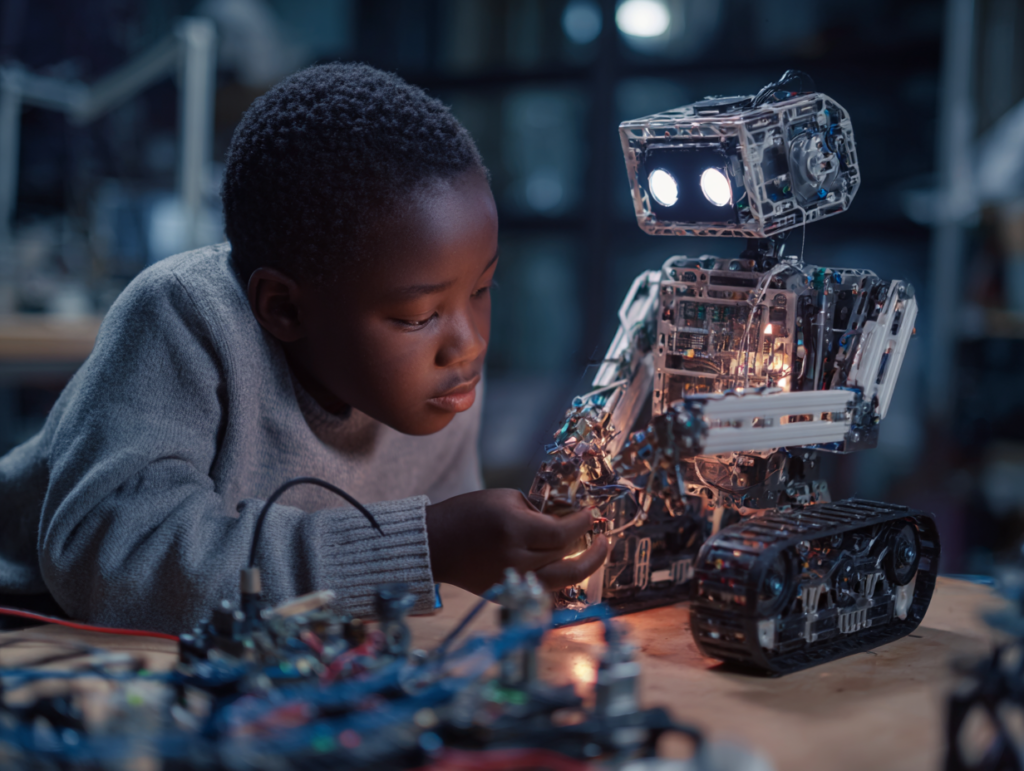
When people think about the future of children in an AI-driven world, the focus often turns to skills:
- coding
- technical literacy
- familiarity with tools
These are not irrelevant.
But they are not the core.
Because tools change quickly.
What remains more stable is how a person relates to change itself.
Adaptability Over Specific Skills
A child may learn a specific tool today, and find it outdated in a few years.
But the ability to adapt—to approach something new with curiosity rather than resistance—remains valuable across contexts.
This kind of adaptability is not built through constant exposure to new tools alone.
It develops through:
- encountering the unfamiliar
- engaging with it
- gradually making sense of it
Awareness as a Foundation
In a fast-changing environment, awareness becomes a stabilizing factor.
Not awareness in a vague sense—but the ability to notice:
- how one is thinking
- how one is reacting
- how external systems are influencing perception
This allows a child to move through change without being completely shaped by it.
They are not just reacting.
They are observing as they engage.
Identity Stability in a Fluid World
As environments become more dynamic, identity can become more fluid.
Children are exposed to more perspectives, more information, and more possibilities than ever before.
This can be enriching.
But it can also be disorienting.
Without some internal grounding, it becomes easy to:
- shift constantly based on external input
- define oneself through immediate feedback
- lose a sense of continuity over time
This is why identity development remains important.
Not as something rigid.
But as something that provides continuity within change.
Depth in an Age of Speed
AI accelerates many processes:
- access
- response
- output
But not everything benefits from speed.
Understanding, reflection, and meaning-making still require time.
If everything becomes immediate, the capacity for depth can weaken—not because it is no longer possible, but because it is less often practiced.
Helping children slow down at times—to think, to reflect, to stay with something—becomes a way of preserving depth within speed.
The Role of the Parent, Again
In all of this, the parent’s role is not to predict the future perfectly.
It is to help the child develop qualities that remain useful across different futures.
Not:
- “What exact skills will my child need?”
But:
- “How can my child relate to change, complexity, and uncertainty?”
This shifts the focus from preparation as prediction…
to preparation as development.
Parenting Is Changing Too
As the environment changes, parenting changes with it.
Not suddenly.
Not in a dramatic or visible way.
But gradually—through what is required to guide a child within a different kind of world.
In the past, guidance often meant:
- setting boundaries
- providing information
- correcting behavior
These still matter.
But they are no longer sufficient on their own.
Because the environment children are growing into is more complex, more responsive, and less predictable.
From Control to Awareness
When tools were simpler, control was more effective.
You could limit access.
You could monitor usage.
You could define clear rules.
Now, much of what shapes a child happens beneath the surface:
- in how they think
- in how they interpret
- in how they engage with information
These are not easily controlled from the outside.
They can only be guided through awareness.
Parents as Interpreters of the Environment
In this context, the role of the parent begins to shift.
Not just as a protector or instructor.
But as an interpreter.
Someone who can help the child make sense of:
- what they encounter
- what they feel
- what they believe
This does not require perfect knowledge.
It requires attention.
It requires curiosity.
It requires the willingness to explore alongside the child, rather than always staying one step ahead.
Learning Alongside Children
One of the less obvious changes is this:
Parents are no longer fully ahead of their children when it comes to technology.
In many cases, children explore faster.
They adapt more quickly.
And this can feel uncomfortable.
But it also creates a different kind of opportunity.
Parenting becomes less about transmitting fixed knowledge…
and more about learning together.
Not as equals—but as participants in the same evolving environment.
A More Subtle Form of Guidance
Guidance, in this context, becomes quieter.
Less about giving answers.
More about shaping how questions are asked.
- noticing patterns
- asking thoughtful questions
- creating space for reflection
These are small actions.
But over time, they influence how a child learns to think, relate, and understand.
Returning to What Matters
In the end, much of what matters remains the same:
- attention
- presence
- relationship
Technology does not replace these.
If anything, it makes them more important.
Because in a world where information is abundant,
what becomes rare is clear understanding and grounded connection.
Conclusion: Seeing Clearly in a Changing Environment
What is changing is not only technology.
It is the environment in which children grow, think, and understand the world.
And with that, parenting changes too.
It becomes less about keeping up with tools,
and more about seeing clearly what those tools are doing—
to attention, to learning, to thinking itself.
Throughout this article, we have moved through several layers:
- from AI as a tool to AI as an environment
- from surface behaviors to underlying patterns of thinking
- from simple questions to deeper forms of literacy
None of these require perfection.
They require awareness.
Parents do not need to become experts in technology.
But they do need to develop a certain kind of clarity:
- to notice how their child is engaging with information
- to recognize when thinking is happening—and when it is being bypassed
- to guide, not just by setting limits, but by shaping how their child relates to what they encounter
This is not something that can be solved quickly.
Because it is not a single problem.
It is an ongoing process—one that unfolds as both the child and the environment evolve.
At Alice in AI Land, this is the perspective we are developing further.
Not just how children use AI,
but how they think within it.
Not just what they learn,
but how they come to understand.
Parenting in the age of AI is not about having the right answers.
It is about learning to ask better questions—and helping children do the same.
Frequently Asked Questions
What does “parenting in the age of AI” mean?
Parenting in the age of AI means helping children grow, think, and learn in a world where artificial intelligence is part of their everyday environment.
It’s not just about managing screen time or tools. It’s about understanding how AI shapes thinking, attention, learning habits, and identity—and guiding children accordingly.
Is AI good or bad for children?
AI is neither inherently good nor bad—it depends on how it is used.
AI can support learning, curiosity, and creativity. But it can also reduce independent thinking if overused or used passively.
The key is not avoidance, but guided use.
Should children use AI tools like ChatGPT?
Yes—but with guidance.
Children can benefit from AI tools when they use them to:
explore ideas
ask questions
deepen understanding
However, relying on AI for instant answers without thinking can weaken internal problem-solving skills.
What is AI literacy for parents?
AI literacy for parents means understanding:
what AI tools do (and don’t do)
how they shape thinking and behavior
how to guide children’s interaction with them
It is not just technical knowledge—it includes psychological, developmental, and ethical awareness.
What is psychological literacy, and why is it important?
Psychological literacy is the ability to understand how the mind develops and how thinking, emotions, and behavior are shaped.
In the age of AI, this becomes essential—because without it, parents may focus only on tools, while missing how those tools affect:
attention
motivation
identity
learning patterns
How does AI affect children’s thinking?
AI can change how children approach thinking by shifting where thinking begins.
Children may start to:
look for answers externally instead of thinking internally
resolve uncertainty quickly instead of exploring it
retrieve answers instead of constructing understanding
These changes happen gradually through repeated use.
What is systems literacy, and why does it matter?
Systems literacy means understanding how digital platforms and AI products are designed—especially how they make money and influence behavior.
This matters because many systems are optimized for:
engagement
attention
retention
Without this awareness, children may be shaped by systems they don’t understand.
How can parents guide children in using AI?
Parents can guide children by:
encouraging thinking before using AI
asking children to explain answers in their own words
using AI as a tool for exploration, not replacement
discussing how AI works and its limitations
The goal is to keep the child’s thinking active.
Is this similar to the social media problem?
There is a key difference.
With social media, many negative effects became visible only after they were already widespread.
With AI, we have an opportunity to understand its impact earlier—and guide children more intentionally from the beginning.
Should parents limit AI use?
Limiting use can help—but it is not enough on its own.
More important is:
how AI is used
why it is used
what habits it creates
The focus should be on quality of interaction, not just quantity.
Why do you use metaphors like “Alice in AI Land”?
Metaphors help simplify complex ideas.
AI is not just a tool—it is an environment. And environments are easier to understand through stories and images.
The “Alice” metaphor helps parents and children:
visualize abstract concepts
see patterns more clearly
reflect on their own experience
What is the most important takeaway for parents?
The most important takeaway is this:
AI does not just change what children know—it can change how they think.
By understanding this, parents can move from reacting to technology… to guiding development intentionally.