AI Is Not a Tool—It’s an Environment (And That Changes Everything)
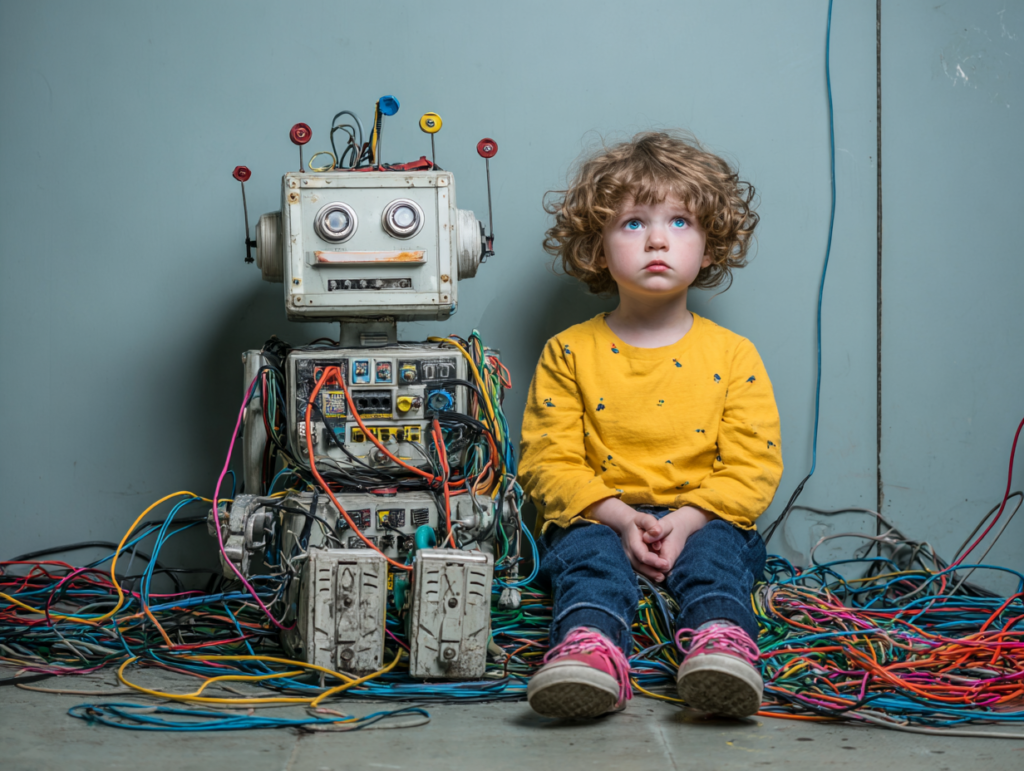
When we think about artificial intelligence and children, the conversation often begins in a familiar place.
We ask questions like:
- How much should children use AI?
- What are the risks?
- How can we control or limit its impact?
Underlying all of these questions is a quiet assumption.
That AI is simply a tool.
Something children pick up, use for a moment, and then put down—
like a calculator, a textbook, or an app.
But this assumption is becoming increasingly difficult to hold.
Because it overlooks something more fundamental.
We have seen this pattern before.
When social media first became widespread, it was also treated as a tool.
A way to communicate, share, and stay connected.
Only later did we begin to realize that it was doing something more.
It was shaping attention.
Influencing self-image.
Altering how identity and social comparison developed.
And by the time these questions became widely discussed…
Social media was no longer optional.
It had already become part of the environment of growing up.
Now, a similar shift is happening again.
But this time, it is unfolding faster—and at a deeper level.
Because artificial intelligence is not just changing what children can do.
It is beginning to change the conditions in which they develop.
And if we continue to think of it only as a tool…
We risk asking the wrong questions from the very beginning.
From Tool to Environment
To understand what is changing, we need to make a simple—but powerful—distinction.
The difference between a tool and an environment.
A tool is something we use occasionally.
It serves a function, and then we put it aside.
An environment is different.
We don’t just use it.
We live inside it.
A child does not “use” a family environment.
They develop within it.
A teenager does not “use” a social environment.
Their identity takes shape through it.
Environments are not just things we interact with.
They are forces that continuously shape how we think, feel, and behave.
When we apply this distinction to artificial intelligence, something important becomes visible.
AI is not only something children use to complete tasks or find information.
It is becoming part of the environment that:
- responds to them
- adapts to their behavior
- and influences what they see, learn, and focus on
Unlike earlier tools, these systems are:
- interactive
- personalized
- and continuously evolving
They do not remain static.
They change in response to the user.
And this creates a different kind of influence.
Instead of occasional interaction…
There is ongoing shaping.
Instead of neutral exposure…
There is adaptive feedback.
Instead of a fixed experience…
There is a dynamic, responsive system.
This is the shift.
Artificial intelligence is not simply entering children’s lives as another tool.
It is becoming part of the developmental environment itself.
And once we begin to see this clearly, something else follows.
The question is no longer:
“How should children use AI?”
But:
“How does development unfold inside environments that think, respond, and adapt?”
That question leads us to something equally important.
Because while the environment is changing…
The developing mind itself follows patterns that are much more stable.
And understanding those patterns is where clarity begins.
What Hasn’t Changed: The Foundations of Development

As much as the environment is changing, something equally important remains the same.
The way the human mind develops.
Children today may be surrounded by new technologies, new platforms, and new forms of interaction.
But the underlying processes shaping their development are not new.
They are still building:
- emotional systems
- patterns of attention
- a sense of identity
- and the ability to regulate themselves over time
A child is not born with a finished mind.
They are born with a system that is under construction.
Neural connections are forming.
Emotional responses are organizing.
Experiences are gradually shaping how they interpret the world—and themselves.
This development does not happen automatically.
It depends on interaction.
- relationships
- experiences
- challenges
- and time
One of the most important aspects of this process is something we rarely notice directly.
Friction.
Development requires moments that are not smooth.
- frustration
- waiting
- misunderstanding
- conflict
- emotional discomfort
These experiences are not interruptions to development.
They are part of how development happens.
Through these moments, children gradually build:
- emotional resilience
- frustration tolerance
- the ability to pause and reflect
- and a more stable sense of self
At the same time, identity is taking shape.
Often quietly.
Often unconsciously.
Children and adolescents are constantly asking:
- Who am I?
- How do others see me?
- Where do I belong?
And the answers to these questions are not taught directly.
They are formed through repeated experiences over time.
This leads to an important realization.
Even in a rapidly changing world…
Development is still grounded in emotion, experience, and relationship.
The human mind has not changed as quickly as the environments surrounding it.
And this creates a kind of tension.
Because now, these long-standing developmental processes are unfolding inside conditions that are very different from those of previous generations.
To understand what that means, we need to look more closely at those new conditions.
Because while development follows familiar patterns…
The forces shaping it are becoming increasingly unfamiliar.
What Has Changed: The New Conditions of Development
If the developing mind still follows familiar patterns…
Then what has actually changed?
The answer lies in the conditions surrounding that development.
Because today, children are growing up inside environments that are not only digital—
but designed, adaptive, and continuously responsive.
To understand the impact of this shift, we can look at three changes that are especially important.
1. Attention Is Now Actively Engineered
In earlier environments, attention was influenced by what was present.
- people
- activities
- surroundings
Today, attention is something many systems are actively competing for.
Notifications, recommendations, and endless streams of content are not random.
They are designed to keep users engaged.
For adults, this can already be powerful.
For children—whose ability to regulate attention is still developing—
it can be deeply shaping.
Because attention is not just about what we focus on.
It determines:
- what we learn
- what we remember
- what we return to
- and what becomes familiar
In this sense:
attention is not just directed anymore—it is increasingly designed.
2. Feedback Is Continuous and Visible
Human beings are highly sensitive to social feedback.
Approval, rejection, belonging, and comparison all play a role in how we understand ourselves.
This is especially true during adolescence.
In digital environments, feedback becomes:
- immediate
- visible
- and often measurable
Through:
- likes
- comments
- reactions
- follower counts
This changes how identity develops.
Instead of forming primarily through lived experience and close relationships…
It can become tied to visible signals of approval.
Over time, this can shift the center of identity toward something external.
Something that is:
- constantly evaluated
- and constantly adjusted
3. Experience Is Algorithmically Shaped
Perhaps the most subtle change is how experiences are selected.
In the past, what a child encountered was largely shaped by:
- family
- school
- community
Today, much of what they see is filtered through algorithmic systems.
These systems learn from behavior.
- what is clicked
- what is watched
- what is engaged with
And then they adjust.
Showing more of what keeps attention…
And less of what does not.
This creates something new.
Not just access to information—
But a personalized stream of experience.
Two children can use the same platform…
And gradually begin to see entirely different worlds.
This means:
children are not only exploring the world
the world is being selected for them
The Combined Effect
When we bring these together, a pattern begins to emerge.
A developing mind—already:
- sensitive to emotion
- shaped by feedback
- and forming identity
is now interacting with systems that:
- capture attention
- amplify feedback
- and filter experience
This does not mean that development is worse.
But it does mean that it is happening under different conditions.
And when conditions change…
The way development unfolds can change as well.
To understand what that leads to, we need to take one more step.
Because when development meets these new environments…
Something important happens.
Not replacement.
But amplification.
The Core Insight: AI Amplifies Development
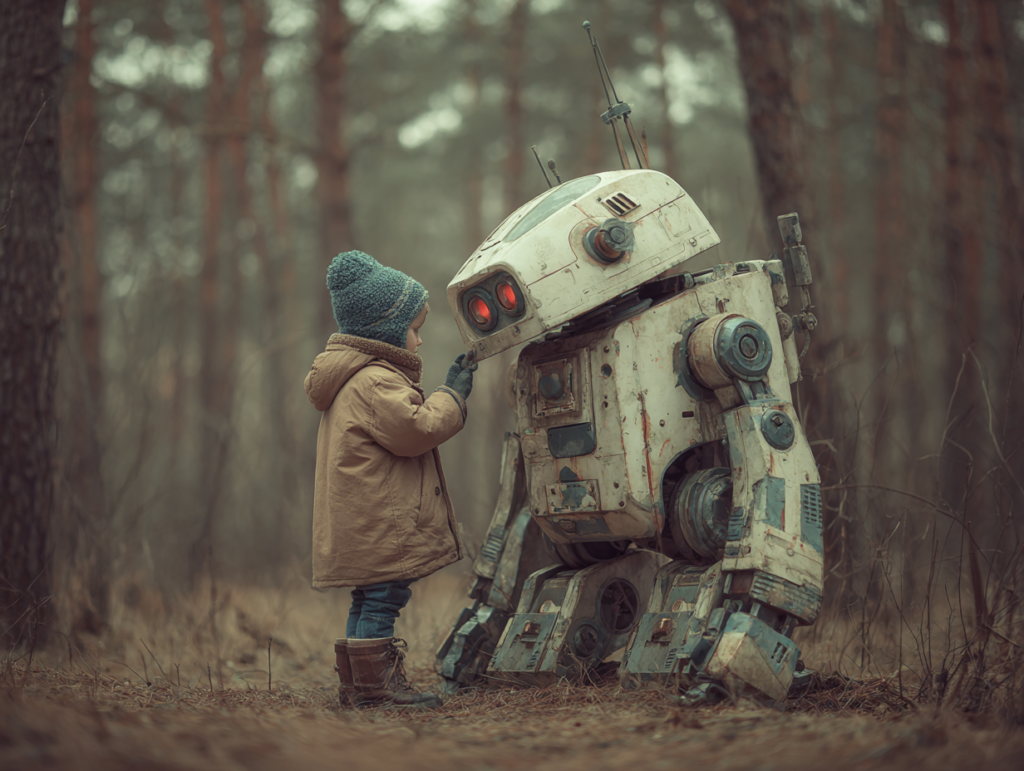
When we put these pieces together, a clearer picture begins to emerge.
Children are still developing:
- emotional systems
- patterns of attention
- a sense of identity
- and the ability to regulate themselves
At the same time, they are now growing up inside environments that:
- capture attention
- provide continuous feedback
- and shape experience in adaptive ways
What happens when these two meet?
A common assumption is that artificial intelligence is changing development itself.
But that is not quite accurate.
A more precise way to understand it is this:
Artificial intelligence does not replace development.
It amplifies whatever is already developing.
This distinction is subtle, but important.
Because it shifts how we interpret both risk and opportunity.
If a child is developing:
- strong emotional awareness
- resilience
- and a stable sense of self
Then these qualities can be expressed, extended, and even strengthened within digital environments.
But if a child is developing:
- sensitivity to external validation
- difficulty regulating emotion
- or a fragile sense of identity
Then those patterns can also be intensified.
The environment does not decide what develops.
But it can influence how strongly and how quickly certain patterns take shape.
This is why the same system can have very different effects on different children.
It is not only about the technology itself.
It is about the interaction between:
- the developing mind
- and the environment surrounding it
In this sense, artificial intelligence acts less like a cause…
And more like a multiplier.
It can:
- accelerate certain tendencies
- reinforce certain behaviors
- and deepen certain patterns
This leads to an important realization.
If we focus only on controlling the technology…
We may overlook the more fundamental process.
Because development is already happening.
With or without AI.
The question is not only:
“What is this system doing to the child?”
But also:
“What is already developing in the child that this system might amplify?”
And this is where the perspective begins to shift.
Because once we see AI as an amplifier…
The focus naturally moves away from control—
and toward understanding development itself.
This shift changes how we approach the entire problem.
And it leads directly to something that is often misunderstood.
Why many common conversations about children and technology miss the deeper point.
The Missing Perspective: Why This Is Often Misunderstood
Once we see that development is being amplified, not replaced…
It becomes easier to understand why many common conversations about children and technology feel incomplete.
Most discussions tend to focus on the surface.
- screen time limits
- content restrictions
- parental controls
- specific tools or platforms
These concerns are not wrong.
But they often assume something deeper:
That the main influence comes from the technology itself.
And this is where the misunderstanding begins.
Because by the time a child interacts with a digital system…
Development is already underway.
A child does not enter AI as a blank slate.
They enter with:
- existing emotional patterns
- emerging identity structures
- habits of attention
- and ways of relating to feedback
So when we observe outcomes—
distraction, comparison, emotional reactivity, or even positive engagement—
it is easy to attribute them entirely to the technology.
But what we are often seeing is something more complex.
Not just what the system is doing…
But what the system is interacting with.
This is why two children can have very different experiences in similar environments.
One may become more:
- creative
- curious
- and expressive
While another may become more:
- dependent on feedback
- distracted
- or emotionally reactive
The difference is not only in the system.
It is in the interaction between:
- the system
- and the developing mind
When we miss this, we are left with limited strategies.
We try to:
- restrict exposure
- control usage
- or react to outcomes
But these approaches often address symptoms, not processes.
Because the deeper process is continuous.
Development is happening:
- before
- during
- and beyond
any specific moment of technology use.
And this leads to a more useful perspective.
Instead of asking:
“How do we manage AI?”
We begin to ask:
“How do we support development in a world where AI is part of the environment?”
This shift may seem small.
But it changes everything.
It moves the focus from:
- external control
to:
- internal development
And once that shift happens, a different kind of approach becomes possible.
One that does not depend on predicting every new technology…
But on understanding something more stable.
The developing mind itself.
The Implication: It’s Not About Managing AI
If artificial intelligence amplifies development…
and if development is already underway before any interaction with technology…
Then something important follows.
The central challenge is not:
how to manage AI.
It is:
how to support the development of the mind that is encountering it.
This is a different kind of problem.
Because if we focus only on the technology, we are always reacting.
- new platforms emerge
- new tools appear
- new risks are discussed
And the response becomes:
- adjust rules
- update restrictions
- try to keep up
But the environment will continue to evolve.
And it will often evolve faster than our ability to respond to each change individually.
This makes control alone an unstable strategy.
What remains more stable is the developing system itself.
A child who gradually builds:
- emotional awareness
- the ability to regulate impulses
- a sense of identity that is not entirely dependent on external validation
- and the capacity to reflect before reacting
will not interact with digital environments in the same way as a child who has not yet developed these capacities.
The difference is not in the technology.
It is in the mind that meets it.
This shifts the role of guidance.
Instead of trying to shape every external condition…
We begin to focus on strengthening internal capacities.
Because those capacities travel with the child.
Across platforms.
Across systems.
Across future technologies that do not yet exist.
This does not mean that boundaries and structure are unnecessary.
They still matter.
But they become part of a larger approach.
Not the entire strategy.
And this leads to something practical.
Not in the form of rules…
But in the form of perspective.
Development is not something that happens only during “important moments.”
Or only when a child is using technology.
It is happening all the time.
In everyday situations:
- when a child experiences frustration
- when they seek approval
- when they navigate social interaction
- when they reflect—or react—under pressure
These moments may seem small.
But they are not separate from digital life.
They are preparing the mind for it.
The way a child learns to handle:
- emotion
- feedback
- attention
- and identity
in everyday life…
becomes the way they navigate:
- digital environments
- social platforms
- and AI systems
In this sense:
we are not preparing children for technology later
we are shaping how they will meet it now
And this naturally leads to a deeper question.
If external control is not enough…
And if internal development is central…
Then what kind of understanding do we actually need?
The Anchor: Why Psychological Understanding Matters More Than Ever

If the environment is changing rapidly…
and if development is being amplified rather than replaced…
Then the most reliable point of guidance is not the technology.
It is our understanding of the mind itself.
Technology evolves quickly.
- platforms change
- systems improve
- new forms of interaction emerge
What feels new today may be outdated tomorrow.
But the core processes of development are far more stable.
- how emotions shape behavior
- how identity forms over time
- how attention influences learning
- how regulation is gradually built through experience
This is why a deeper kind of understanding becomes essential.
Not just awareness of tools…
Psychological literacy means seeing beyond surface behavior.
It means understanding:
- why a child reacts the way they do
- how experiences accumulate into patterns
- how identity is shaped through repeated feedback
- and how regulation develops gradually, not instantly
With this kind of understanding, something shifts.
Instead of reacting to each new technological change…
You begin to recognize underlying processes that remain consistent across environments.
A child seeking validation online is not a new phenomenon.
It is an extension of a deeper developmental process.
A child struggling with attention in digital environments is not only facing a technological problem.
It is also navigating a developing system of focus and self-regulation.
When we see these patterns clearly, the situation becomes less overwhelming.
Because we are no longer trying to solve every new problem separately.
We are understanding the system that generates them.
This creates a more stable foundation.
Instead of constantly adapting to external change…
We build the ability to guide development within it.
And this leads to something important.
The goal is not to eliminate complexity.
Or to perfectly predict every new influence.
The goal is to develop:
a way of seeing that allows us to respond wisely, even in unfamiliar situations
And this kind of understanding does not come from isolated tips or quick solutions.
It comes from seeing the relationship between:
- development
- environment
- and experience
as a connected system.
Which brings us to the final step.
Because once we begin to see this clearly…
The question is no longer what is happening.
But what we choose to do with that understanding.
The Real Responsibility
Children today are growing up in a world that is still taking shape.
The systems influencing their attention, emotions, and identity are evolving in real time.
Which means something important.
We are not guiding them within a fixed environment.
We are guiding them through a changing one.
This can feel uncertain.
Because there is no complete map.
No final set of rules that will remain valid as technology continues to develop.
But there is something more stable.
The processes of human development.
How children:
- experience emotion
- form identity
- respond to feedback
- and gradually learn to regulate themselves
These processes remain the foundation.
Even as the environments around them change.
This is where responsibility becomes clearer.
It is not about predicting every new technology.
Or controlling every possible influence.
It is about developing the ability to see:
- what is happening within the child
- what is happening in the environment
- and how these two are interacting
Because when we can see this interaction…
We are no longer reacting blindly.
We are guiding with awareness.
And that changes the role we play.
We are not simply setting limits.
We are not only managing exposure.
We are helping shape:
- how a child understands themselves
- how they relate to others
- and how they navigate increasingly complex systems
In this sense:
we are not just raising children for today’s world
we are helping them develop minds that can adapt to worlds we cannot fully predict
That is the deeper task.
And it begins, not with technology…
But with understanding development itself.
Frequently Asked Questions
What does it mean that AI is an environment, not a tool?
AI is often seen as something children use, like a calculator or an app. But in reality, AI increasingly surrounds children—shaping how they learn, think, and interact. This makes it an environment they grow inside, not just a tool they occasionally use.
When something becomes an environment, it doesn’t just assist behavior—it forms identity, perception, and development over time.
How does AI affect child development?
AI affects child development by influencing learning patterns, attention, problem-solving, and emotional interaction. It changes how children access information and how quickly they receive feedback.
More importantly, AI can amplify existing developmental patterns—supporting growth when guided well, or reinforcing weaknesses when left unchecked.
Is AI good or bad for children?
AI is neither inherently good nor bad. Its impact depends on how it is used and integrated into a child’s environment.
Instead of asking whether AI is good or bad, a better question is:
What kind of developmental environment are we creating for the child?
At what age should children start using AI?
There is no universal “correct age.” What matters more is how AI is introduced rather than when.
Younger children benefit most when AI is:
guided by adults
used in moderation
integrated with real-world experiences
The goal is not early exposure, but healthy integration.
Can AI replace learning or thinking for children?
No, AI cannot replace true learning or thinking. However, it can simulate both, which may create the illusion of understanding.
If children rely too heavily on AI for answers, they may skip the deeper cognitive processes required for real learning. That’s why guidance is essential—to ensure AI supports thinking rather than replaces it.
How can parents guide children in an AI-driven world?
Parents should focus less on controlling AI and more on shaping how children relate to it.
This includes:
encouraging curiosity and questioning
discussing how AI works and its limits
balancing digital interaction with real-world experiences
The goal is to raise a child who can navigate environments consciously, not just follow them.
Does AI affect children’s emotional development?
Yes, AI can influence emotional development, especially as children interact with increasingly human-like systems.
These interactions may shape:
attachment patterns
communication styles
expectations from relationships
This makes it important for children to also experience real human connection and emotional complexity.
What is the biggest risk of AI for children?
The biggest risk is not AI itself, but passive exposure.
When children grow inside an environment without understanding it, they may:
adopt its patterns unconsciously
lose agency
become shaped rather than self-directed
Awareness and guidance transform this risk into an opportunity.
What is the biggest opportunity of AI for child development?
AI can become a powerful amplifier of learning, creativity, and exploration.
When used consciously, it can:
accelerate understanding
support curiosity
personalize learning experiences
The key is not avoiding AI, but using it to enhance development rather than replace it.
How should education change in the age of AI?
Education should shift from memorization to:
critical thinking
emotional intelligence
adaptability
In a world where AI can provide answers instantly, the real skill becomes:
knowing how to think, not just what to know