Why Most Parenting Advice About AI Is Shallow — And What Actually Helps

If you are a parent trying to understand what artificial intelligence means for your child, you are not short on advice.
There are lists of “safe AI tools for kids,” guides on how to block or monitor usage, warnings about cheating, creativity loss, attention damage, and essays predicting either a golden age of learning or a cognitive collapse. Most of it is well-intentioned. Much of it sounds urgent. And almost all of it feels strangely familiar.
This advice feels reassuring because it offers clarity in a moment of uncertainty. When a new technology enters children’s lives quickly and invisibly, parents naturally look for rules, boundaries, and expert recommendations. Clear instructions reduce anxiety. They create the sense that the situation is manageable.
But reassurance is not the same thing as usefulness.
Most AI parenting advice treats the issue as a tool-management problem:
- Which apps are allowed
- How much time is acceptable
- What features are dangerous
- Where the line between help and cheating lies
These are not irrelevant questions—but they are surface-level ones. They focus on what children are using rather than what kind of minds children are developing while using it.
This is why so much advice feels oddly thin. It addresses behavior without addressing development. It offers rules without explaining what those rules are meant to protect or strengthen. And it assumes that the primary task of parenting in the age of AI is control, rather than guidance.
In moments of technological change, parents are often handed a checklist. What they actually need is a framework.
The Core Problem: Treating AI as the Threat
The most common assumption behind shallow AI parenting advice is simple and intuitive:
AI is the danger.
It is framed as the force that will:
- Replace thinking
- Undermine creativity
- Make learning lazy
- Short-circuit effort
- Erode attention and patience
From this perspective, the task of parenting becomes defensive. The goal is to keep AI at a safe distance, limit exposure, and preserve a pre-AI version of childhood for as long as possible.
The problem is that this framing gets the causal direction wrong.
AI does not weaken children on its own. It amplifies existing strengths and existing weaknesses.
A child with fragile frustration tolerance will use AI to escape difficulty faster.
A child with weak confidence in their own thinking will rely on AI’s authority.
A child who struggles to form a sense of authorship will imitate rather than create.
But the opposite is also true.
A curious child can use AI to explore ideas more deeply.
A reflective child can use it to test and refine their thinking.
A child with a stable sense of self can treat AI as a tool, not a voice.
When AI becomes a problem, it is rarely because the technology appeared. It is because it entered a developmental landscape that was already uneven.
This is the critical point that most advice misses:
AI does not create psychological gaps. It exposes them.
By treating AI as the enemy, parents are encouraged to fight the wrong battle. They are taught to focus on restriction rather than resilience, avoidance rather than skill-building, and moral rules rather than cognitive development.
This leads to fragile strategies—ones that work only as long as the rules can be enforced. And in a world where AI is increasingly embedded in education, work, and daily life, enforcement has a short lifespan.
The real challenge is not keeping AI away from children.
It is helping children grow into minds that are not overpowered by it.
What Shallow Advice Misses: Development Comes First
One reason AI parenting advice feels inadequate is that it starts in the wrong place. It begins with technology and works backward toward the child.
Healthy development works the other way around.
Children do not experience AI as a neutral tool. They experience it through their developmental capacities—their ability to tolerate uncertainty, to persist through difficulty, to form a sense of “this thought is mine,” and to emotionally regulate when things feel hard or confusing.
Most advice skips these foundations entirely.
Instead of asking how children learn, how motivation develops, or how identity forms in a digital environment, it jumps straight to usage rules. But rules only work when the underlying psychological structures are already in place. When they are not, rules become brittle—easily bypassed, resented, or abandoned altogether.
This is why two children can use the same AI tool with radically different outcomes. One becomes more capable and curious. The other becomes passive and dependent. The difference is not the software. It is the developmental readiness of the mind using it.
Parents are often told they need “AI literacy.”
In reality, they need psychological literacy.
Understanding how children:
- deal with frustration
- respond to authority
- form confidence in their own thinking
- experience effort and reward
matters far more than knowing the latest AI feature or platform.
Without this understanding, AI guidance becomes guesswork. With it, parents can adapt to almost any technological shift.
AI as a Friction-Remover — And Why That Matters

One of the least discussed but most important effects of AI on childhood development is this:
AI removes friction.
Friction is the experience of:
- not knowing the answer immediately
- feeling stuck
- making imperfect attempts
- sitting with confusion
- trying again
This kind of friction is not a bug in learning. It is the mechanism by which learning happens.
Traditionally, children developed thinking skills by moving through difficulty. Effort came before clarity. Mistakes came before understanding. Confidence emerged slowly, as a byproduct of persistence.
AI changes this sequence.
When answers arrive instantly, when outputs are polished, and when uncertainty can be bypassed with a prompt, the emotional experience of learning shifts. Difficulty no longer signals “stay with this.” It signals “skip this.”
This does not mean AI should be avoided. But it does mean that unexamined AI use can quietly remove the very experiences children need to grow.
Shallow advice responds to this by saying things like “limit AI use” or “balance screen time.” These recommendations sound sensible, but they miss the underlying issue. The risk is not time spent with AI. The risk is frictionless cognition—a pattern where thinking is continuously outsourced before it has a chance to develop.
When children consistently bypass effort:
- frustration tolerance weakens
- confidence becomes externalized
- learning feels shallow even when outputs look impressive
Over time, this can subtly change how a child relates to their own mind.
The question for parents, then, is not simply how much AI is used. It is when it is used—and what mental step disappears when it enters the process.
That distinction changes everything.
From Control to Calibration: A Better Way to Guide AI Use
Once AI is no longer framed as an enemy, parenting advice can shift from control to calibration.
Control asks:
How do we restrict this?
Calibration asks:
How do we help a child use this well, at the right time, for the right reasons?
This shift matters because restriction alone does not teach judgment. And judgment is the skill children will need long after specific rules stop working.
Ask Better Questions
Instead of asking:
- “Should my child be using AI for this?”
- “Is this allowed or not?”
Parents can ask:
- “What thinking step does AI replace here?”
- “What discomfort is being bypassed?”
- “What skill should exist before this shortcut makes sense?”
These questions do not require technical expertise. They require attention.
They also transform AI from a hidden influence into a visible part of the learning process—something that can be discussed, evaluated, and adjusted rather than feared or ignored.
The Scaffold vs. Shortcut Distinction (A Practical Rule That Actually Works)
One of the most useful ways to guide AI use is to distinguish between scaffolds and shortcuts.
A scaffold supports thinking after effort.
A shortcut replaces thinking before effort.
This single distinction gives parents a reliable, repeatable framework.
AI as a Scaffold
- Reviewing work that a child has already attempted
- Offering alternative explanations after confusion
- Expanding ideas that originated with the child
- Helping reflect on mistakes
Here, AI strengthens learning because it builds on something already present.
AI as a Shortcut
- Generating answers before thinking begins
- Writing finished work without visible effort
- Solving problems the child has not tried to solve
- Providing opinions before questions are formed
Here, AI weakens learning—not because it exists, but because it arrives too early.
A simple, practical habit emerges from this:
Effort first. Assistance second.
Parents do not need to ban AI to apply this rule. They only need to insist that thinking comes before prompting.
What Actually Helps: Small, Repeatable Parenting Moves
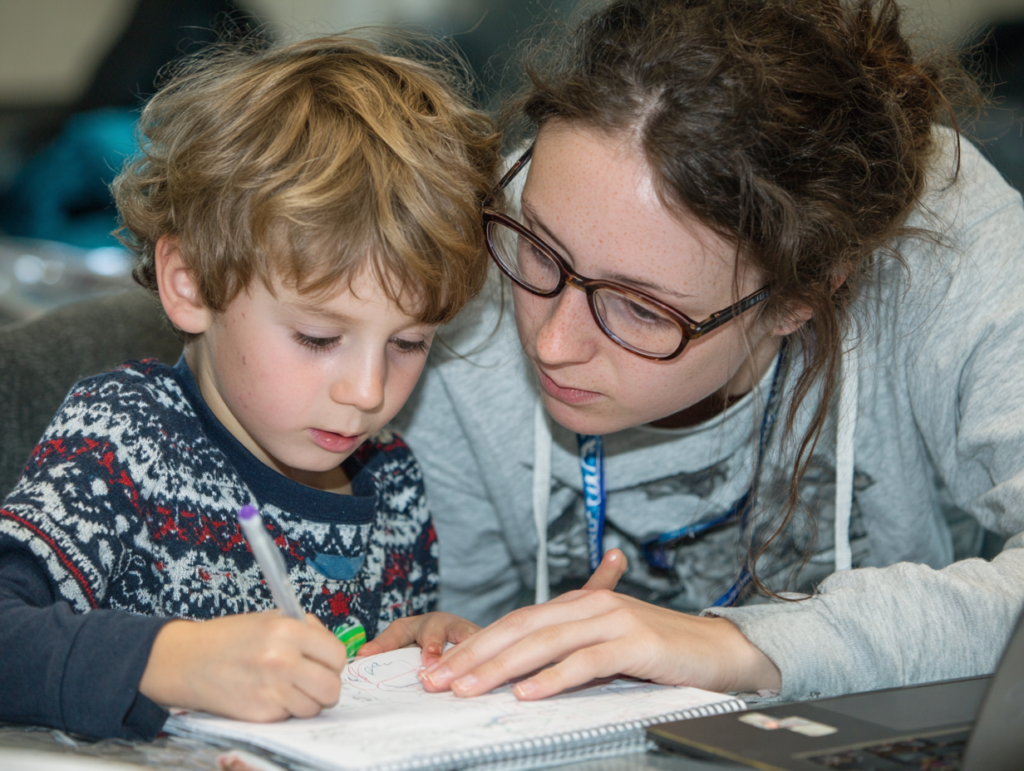
Good guidance does not require dramatic interventions. It works through small, consistent habits.
Make Thinking Visible
Encourage children to articulate:
- what they already know
- what they are confused about
- what they hope AI will help clarify
This builds metacognition—the ability to think about one’s own thinking—which is far more protective than any restriction.
Preserve “Answerless Time”
Not every question needs to be resolved immediately. Allowing children to sit with uncertainty:
- strengthens emotional regulation
- builds patience
- reinforces that confusion is tolerable
This counteracts AI’s tendency to eliminate all waiting.
Model Thoughtful Use
Children learn how to relate to tools by watching adults.
When parents:
- think aloud
- struggle visibly
- delay asking AI
- explain why they are using it
they teach discernment without lecturing.
Rules tell children what to do.
Models show them how to think.
AI as a Mirror, Not a Villain
When parents look closely, AI becomes less of a threat and more of a mirror.
It reflects:
- how a child handles effort
- how they relate to authority
- how comfortable they are with uncertainty
- how strong their sense of authorship is
Used this way, AI becomes diagnostic. It reveals where support is needed—not because it causes weakness, but because it exposes it.
This is far more useful than treating AI as something to be kept at bay.
Parenting Beyond Tools
AI will continue to change. New systems will appear. Rules written today will expire quickly.
What does not expire are the internal skills children carry forward:
- the ability to think independently
- the capacity to tolerate difficulty
- the confidence to say “this idea is mine”
The goal of parenting in the age of AI is not to preserve a pre-AI childhood.
It is to help children grow minds that remain strong within a changing world.
That work begins not with better tools—but with deeper understanding.
Frequently Asked Questions
Is artificial intelligence bad for children?
No. Artificial intelligence is not inherently bad for children. Its impact depends on how and when it is used, and on the child’s developmental readiness. AI can support learning and curiosity when used thoughtfully, but it can weaken thinking if it replaces effort too early. AI is best understood as an amplifier—it strengthens existing habits rather than creating them from scratch. Children with strong thinking skills tend to use AI as a tool; children with fragile skills may use it as a substitute. The key factor is development, not the technology itself.
Should parents limit or ban AI use for kids?
Banning AI is usually ineffective long-term. Instead of focusing only on limits, parents should focus on teaching discernment—when AI helps learning and when it undermines it. Rules are temporary, but skills scale. Children will encounter AI in school, work, and daily life regardless of household restrictions. Teaching how to use AI thoughtfully is more durable than trying to keep it out entirely.
What is the biggest risk of AI use for children?
The biggest risk is not screen time or exposure—it is the removal of cognitive friction. When AI consistently eliminates struggle, uncertainty, and effort, children may lose opportunities to develop frustration tolerance and independent thinking. Learning depends on difficulty. If answers always arrive instantly, children may stop forming questions and rely on external systems to think for them. This risk is subtle and cumulative, which is why it is often overlooked.
How can parents tell if AI use is helping or harming learning?
A simple test is to ask whether effort comes before assistance. If a child tries, struggles, and then uses AI to refine or check their thinking, AI is helping. If AI replaces thinking before effort begins, it is likely harming development. This is often described as the difference between AI as a scaffold versus AI as a shortcut. Scaffolds support growth; shortcuts bypass it.
At what age should children start using AI tools?
There is no universal age. Readiness depends on a child’s ability to tolerate frustration, reflect on their thinking, and understand that AI outputs are not the same as understanding. Younger children benefit most from human interaction, dialogue, and guided exploration. As children mature, AI can gradually become a reflective tool rather than a primary source of answers.
How can parents guide AI use without becoming overly controlling?
Parents can shift from rule-setting to conversation. Asking children why they used AI, what they hoped it would help with, and what they learned afterward builds judgment without constant enforcement. Parents do not need technical expertise to guide AI use. They need attentiveness to thinking processes, emotional responses, and patterns of avoidance or engagement.
Does AI reduce creativity in children?
AI does not automatically reduce creativity, but it can interfere with authorship if children rely on it to generate ideas before forming their own. Creativity depends on ownership. When children feel that ideas originate outside themselves, confidence and originality can weaken. Encouraging children to generate first drafts or rough ideas before using AI helps preserve creative development.
What matters more than AI rules in parenting today?
Psychological development matters more than any specific AI rule. Skills like frustration tolerance, metacognition, emotional regulation, and confidence in one’s own thinking determine how children adapt to technology. Technologies will change quickly. Internal skills last.
What is the best mindset for parents navigating AI and children?
The most helpful mindset is to treat AI as a mirror, not a villain. AI reveals how children handle effort, uncertainty, and authority. When parents stop asking how to control AI and start asking what it reveals about their child’s development, guidance becomes calmer, wiser, and more effective.