The Missing Half of AI Literacy: What Children Really Need to Understand AI

Over the past few years, the phrase AI literacy has started appearing everywhere. Schools are discussing it. Governments are funding programs for it. Technology companies are promoting it as an essential skill for the future.
Usually, AI literacy is described in technical terms: learning how artificial intelligence works, understanding tools like ChatGPT, recognizing the limitations of AI systems, and using these technologies responsibly.
These are important skills. But they only describe part of the challenge.
Children today are not simply learning to use new tools. They are growing up inside an entirely new digital environment shaped by algorithms, recommendation systems, and AI-generated information.
In such a world, understanding technology alone is not enough. True AI literacy also requires understanding the human mind, the systems shaping digital platforms, and the ways information spreads and becomes believable.
In other words, the most important part of AI literacy may not be technical at all.
AI Is Not Just a Tool — It Is an Environment
Artificial intelligence is often presented as a new kind of tool, similar to earlier technologies such as calculators, search engines, or educational software. From this perspective, AI literacy simply means learning how to use these tools effectively.
But the situation today is different.
AI is becoming part of a much larger digital environment that shapes how information appears, how ideas spread, and how people interact with knowledge. Recommendation algorithms decide which videos children see next. Social media platforms amplify certain narratives while quietly burying others. Generative AI systems can produce convincing explanations, images, and stories within seconds.
In other words, children are not just using technology. They are developing their beliefs, interests, and habits of thinking within an environment heavily influenced by intelligent systems.
Understanding AI therefore cannot be limited to understanding a single tool. It requires understanding the broader landscape of systems and incentives shaping the digital world.
The Narrow Definition of AI Literacy
Most current discussions of AI literacy focus primarily on the technical side of the technology.
Educational programs often emphasize questions such as:
- What is artificial intelligence?
- How do large language models work?
- What are prompts?
- Why do AI systems sometimes produce incorrect answers?
- How can we detect AI-generated content?
These topics are certainly useful. Children should have a basic understanding of the tools they encounter.
However, technical knowledge alone does not prepare them for the deeper challenges created by AI-driven environments. A child might understand that a chatbot generates text probabilistically, yet still struggle to evaluate information critically, resist sensational narratives, or recognize how algorithms influence what they see.
When AI literacy focuses only on technical explanations, it leaves out the broader human and social dimensions of the problem.
This is what we might call the missing half of AI literacy.
The Missing Half of AI Literacy
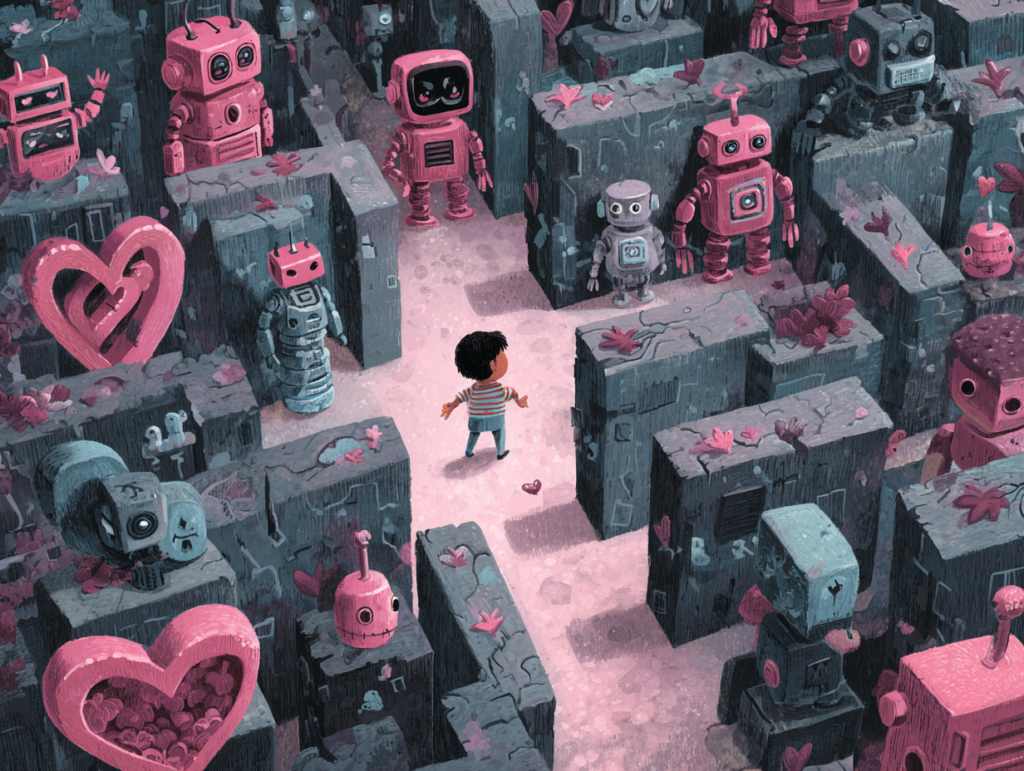
When people talk about AI literacy today, they usually mean understanding artificial intelligence as a technology. This includes learning what AI systems are, how they work in general terms, and how to use them responsibly.
But if we step back and look at the world children are growing up in, it becomes clear that the challenge is broader than technology alone.
Artificial intelligence now interacts with human psychology, digital platforms, and information systems. It shapes what people see, how ideas spread, and how knowledge is presented.
Because of this, navigating an AI-shaped world requires more than one type of literacy.
It requires understanding tools, minds, systems, and information itself.
We can think of this as four interconnected dimensions of AI literacy.
1. Technical Literacy: Understanding the Tools
The most familiar dimension of AI literacy is technical awareness.
Children should have a basic understanding of what artificial intelligence is and how it works at a high level. They should know, for example, that systems like chatbots generate responses based on patterns in large amounts of data, and that these systems sometimes produce incorrect or misleading answers.
This type of literacy helps children use AI tools more thoughtfully. Instead of assuming that an AI system always knows the correct answer, they learn to treat it as a powerful but imperfect tool.
Technical literacy is important. But it is only the first layer.
Understanding tools alone does not explain why certain information spreads quickly online, why some ideas become dominant, or why people sometimes believe misleading content even when better information is available.
For that, we must also understand ourselves.
2. Human Literacy: Understanding the Mind
Digital environments do not only interact with technology. They interact with human psychology.
People are naturally drawn to emotionally intense information. Stories that provoke anger, excitement, or fear often capture attention more easily than calm explanations. Social approval, group belonging, and emotional reactions can strongly influence how people interpret what they encounter online.
Because of this, AI literacy must also include an understanding of human thinking and emotion.
Children benefit from learning skills such as:
- emotional awareness
- recognizing cognitive biases
- reflecting on their reactions to information
- understanding how attention and emotion influence judgment
These abilities help them notice when a piece of content is designed to provoke a reaction rather than encourage thoughtful reflection.
But human literacy is not only about understanding reactions to information. It also includes understanding how children develop psychologically.
Childhood and adolescence are periods when identity, beliefs, and habits of thinking are still forming. Digital environments—especially those shaped by algorithms and AI-generated content—can influence how children see themselves, how they interpret the world, and what kinds of ideas they encounter repeatedly.
For parents and educators, some knowledge of psychology and child development can therefore become an important part of AI literacy. Understanding how children develop emotionally and cognitively allows adults to guide them more effectively through digital environments.
Instead of reacting only to individual technologies, parents can focus on helping children develop deeper capacities such as:
- self-awareness
- emotional regulation
- critical thinking
- a stable sense of self
These abilities act as internal anchors that help children navigate complex information environments more confidently.
Without this kind of human understanding, even strong technical knowledge may not be enough to help children make wise decisions online.
3. System Literacy: Understanding the Digital Environment

Many digital platforms are built around powerful economic incentives.
Social media platforms, video platforms, and content networks often earn revenue by capturing attention and increasing engagement. As a result, their recommendation algorithms are designed to show content that keeps users watching, clicking, and reacting.
This does not necessarily mean the algorithms are trying to spread misinformation. But it does mean that content that generates strong reactions—surprise, outrage, amusement, or controversy—often spreads more widely than quieter or more nuanced explanations.
Understanding these dynamics is part of what we might call system literacy.
Children can gradually learn that digital environments are shaped by:
- recommendation algorithms
- engagement metrics
- advertising incentives
- platform design choices
When they understand these systems, they start to see the invisible structures influencing what appears in their feeds.
Instead of assuming that the most visible content is also the most reliable, they begin to ask a deeper question:
Why am I seeing this?
But even system awareness is not enough in a world where information itself can be generated instantly.
4. Epistemic Literacy: Understanding How Knowledge Works
Perhaps the most subtle dimension of AI literacy is epistemic literacy—the ability to think about knowledge itself.
In earlier decades, information was relatively scarce. Publishing books, producing videos, or distributing articles required time, resources, and institutions. This created natural filters that slowed the spread of information.
Today, AI systems can generate enormous amounts of content almost instantly.
The challenge is no longer simply finding information. The challenge is evaluating it.
Children growing up in this environment need to develop habits such as:
- comparing multiple sources
- recognizing sensational or emotionally manipulative narratives
- noticing when algorithms amplify certain viewpoints
- understanding how echo chambers form
- questioning how confident a claim really is
These habits help them maintain intellectual independence in environments where persuasive information can appear quickly and convincingly.
Epistemic literacy does not mean becoming skeptical of everything. Rather, it means learning how to navigate a complex information landscape thoughtfully and responsibly.
Why This Matters for Children
Children today are growing up in an environment very different from the one their parents experienced. Information appears instantly. Algorithms quietly shape what people see online. Artificial intelligence can generate convincing explanations, images, and stories within seconds.
In such an environment, simply teaching children how to use digital tools is not enough.
A child might learn how to prompt an AI system, how to search for information online, or how to use new technologies creatively. These are valuable abilities. But the deeper challenge lies in helping children develop the mental and emotional skills required to navigate complex information environments.
Children need to learn how to think about what they encounter. They need to recognize when content is designed to capture attention rather than convey careful understanding. They need the confidence to question information, the patience to compare perspectives, and the emotional awareness to notice when a message is provoking a strong reaction.
This is why the broader dimensions of AI literacy matter so much.
Technical knowledge helps children understand the tools they are using. Human literacy helps them understand their own reactions and thinking patterns. System literacy helps them recognize the invisible structures shaping digital platforms. Epistemic literacy helps them evaluate information and develop intellectual independence.
Together, these abilities form a kind of cognitive resilience—the capacity to navigate complex environments without becoming overwhelmed, misled, or manipulated.
For children growing up in an AI-shaped world, this resilience may become one of the most important skills they can develop.
The Alice in AI Land Perspective
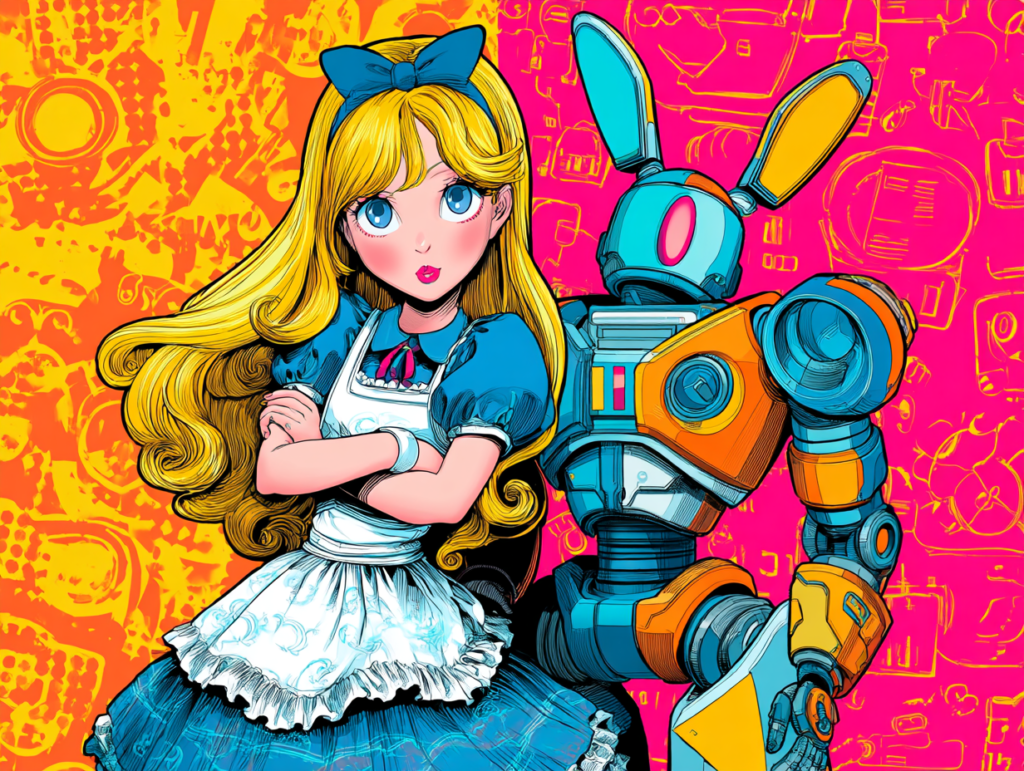
The story of Alice offers a useful metaphor for the world children are entering today.
When Alice falls into Wonderland, she suddenly finds herself in a place where familiar rules no longer seem to apply. Conversations are confusing, authority figures behave unpredictably, and logic sometimes feels strangely distorted. Yet Alice continues exploring with curiosity and careful observation, gradually learning how the strange world around her works.
In many ways, the digital environments shaped by artificial intelligence can feel similar. Information appears quickly and convincingly. Algorithms influence what people see without making their decisions visible. Narratives spread rapidly through networks of attention and reaction.
For children growing up in this environment, the goal of AI literacy is not simply learning to operate new technologies.
It is learning how to move through a complex world with curiosity, awareness, and thoughtful judgment.
In other words, the future will not belong only to those who understand artificial intelligence. It will belong to those who understand both machines and minds—and who can navigate the environments where the two increasingly meet.
Frequently Asked Questions
What is AI literacy?
AI literacy refers to the ability to understand and navigate technologies based on artificial intelligence. It usually includes learning what AI systems are, how they work in general terms, and how to use them responsibly.
However, AI literacy is increasingly understood as something broader than technical knowledge alone. In a world shaped by algorithms and AI-generated information, it also involves understanding how digital systems influence what we see online, how human psychology interacts with technology, and how to evaluate information critically.
Why is AI literacy important for children?
Children are growing up in digital environments where artificial intelligence shapes how information appears, spreads, and becomes believable. Recommendation algorithms, AI-generated content, and attention-driven platforms can influence what children see and how they interpret the world.
Developing AI literacy helps children understand these environments more clearly. Instead of passively absorbing information, they can learn to question sources, recognize how algorithms influence content, and develop the thinking skills needed to navigate complex digital spaces.
Is AI literacy only about learning how AI tools work?
No. Understanding AI tools is only one part of AI literacy.
Children also benefit from learning how human psychology interacts with digital environments, how algorithms influence the spread of information, and how to evaluate knowledge critically. These broader skills help them develop awareness and intellectual independence in a world where information can be generated and amplified very quickly.
What skills should children develop for the age of AI?
Beyond technical knowledge, children benefit from developing skills such as:
critical thinking
emotional awareness
understanding how algorithms shape digital platforms
evaluating information from multiple sources
reflecting on their reactions to online content
These abilities help children build resilience in complex information environments and make more thoughtful decisions when interacting with digital technologies.
How can parents help children develop AI literacy?
Parents do not need to be AI experts to support their children’s development in this area. What often matters most is encouraging curiosity, discussion, and thoughtful questioning about technology and information.
Talking with children about how digital platforms work, asking them how they interpret what they see online, and helping them reflect on emotional reactions to content can all strengthen their awareness. Over time, these conversations help children develop the habits of thinking that are essential for navigating AI-shaped environments.
What is the difference between digital literacy and AI literacy?
Digital literacy traditionally focuses on using digital tools and understanding how to operate technology safely and effectively.
AI literacy builds on this foundation but extends further. It includes understanding how artificial intelligence influences digital environments, how algorithms shape what people see online, and how information can be generated, amplified, or distorted by intelligent systems.
In this sense, AI literacy combines technical awareness with psychological, systemic, and critical thinking skills.
At what age should children start learning about AI?
Children can begin learning about artificial intelligence much earlier than many people assume. At younger ages, the goal is not to explain technical details but to help children understand that digital systems and algorithms influence what they see online.
Simple conversations about how recommendations work, why certain videos appear, or how computers generate answers can already build awareness. As children grow older, these ideas can gradually expand into deeper discussions about technology, information, and critical thinking.
Can artificial intelligence influence how children think?
Artificial intelligence does not directly control how children think, but it can influence the information environments they grow up in.
Recommendation algorithms, AI-generated content, and attention-driven platforms can shape what children repeatedly see online. Over time, these patterns may influence interests, beliefs, and habits of thinking.
This is why helping children develop critical thinking, emotional awareness, and curiosity about how digital systems work is an important part of AI literacy.
How should schools approach AI literacy education?
Schools often begin teaching AI literacy by introducing students to AI tools and explaining basic concepts about artificial intelligence. While this technical understanding is valuable, effective AI literacy education can go further.
Students can also benefit from learning about the psychological and social dimensions of digital environments. Discussions about algorithms, information credibility, emotional influence in media, and responsible technology use can help students build a deeper understanding of the world they are navigating.
When technical knowledge is combined with critical thinking and social awareness, AI literacy becomes a much more meaningful educational goal.