Alice in AI Land: A Metaphor for Growing Up With Machines
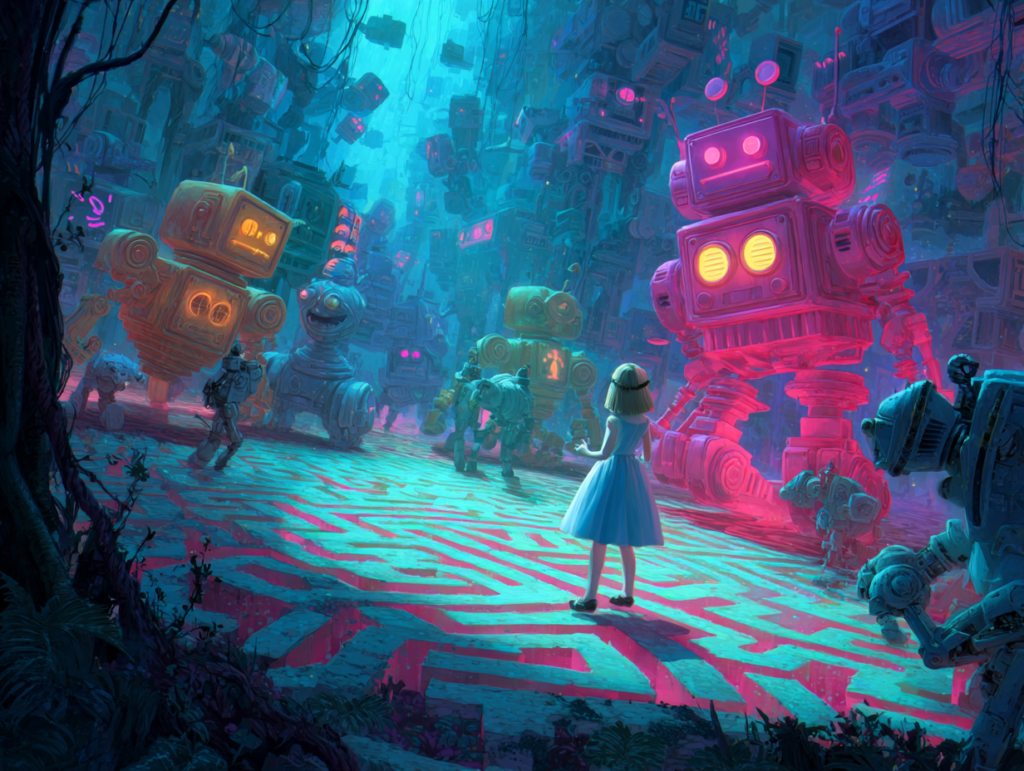
Why We Needed a Metaphor
We are living through a moment that is difficult to explain using ordinary language.
Artificial intelligence is not a single tool, a clear invention, or a visible machine. It doesn’t arrive with instructions that match its effects. It speaks fluently without understanding, responds instantly without experience, and adapts without growing. For adults, this can be confusing. For children, it can quietly reshape how the world feels.
When reality becomes unfamiliar, humans don’t reach for rules first.
They reach for metaphors.
Metaphors help us orient ourselves when direct explanations fail. They don’t simplify the world — they make it navigable. They allow us to talk about things that are still forming, still unstable, still hard to see clearly.
That is why this project is called Alice in AI Land.
Not because artificial intelligence is fantasy.
But because growing up alongside intelligent machines feels disorienting in ways that facts alone cannot capture.
Children are entering environments where answers appear before questions fully form, where systems respond with confidence but no accountability, and where learning can feel frictionless in ways that bypass struggle, confusion, and patience. Nothing about this is inherently malicious. But it is profoundly unfamiliar.
We could describe this moment using technical language — models, datasets, interfaces, safeguards. All of that matters. But technical language alone does not explain what it feels like to grow up inside these systems.
Metaphors allow us to talk about feeling without exaggeration.
They let us notice patterns without panic.
They give us a shared language before we reach for solutions.
Alice in AI Land is not an explanation of AI.
It is a way of noticing what changes when intelligence becomes ambient — when it surrounds childhood rather than appearing occasionally.
This site uses that metaphor carefully, not as decoration, but as orientation.
Not to romanticize technology, and not to demonize it — but to stay human while trying to understand it.
Why AI Feels Like Wonderland
Artificial intelligence rarely feels threatening in obvious ways. It doesn’t arrive loudly. It doesn’t announce itself as a disruption. Most of the time, it feels helpful, efficient, and calm.
And yet, for many people — especially children — it also feels strangely disorienting.
Rules seem to exist, but they are not always visible. Systems respond intelligently, but their reasoning cannot be questioned in the way a human’s can. Authority is present, but it is difficult to locate who holds it or how it operates. Answers appear quickly, sometimes before curiosity has had time to form.
This creates an environment that feels internally consistent, but hard to navigate.
In such environments, traditional markers of learning begin to blur. Effort and outcome no longer have a clear relationship. Mistakes disappear too quickly. Struggle loses its role as a teacher. The process between not knowing and understanding becomes compressed, sometimes invisible.
For adults, this can be unsettling but manageable. Adults carry prior maps — experiences of confusion, failure, delay, and correction that help them interpret what is happening. Children, however, are still building those maps.
When intelligence becomes ambient — present everywhere, responsive at all times — the world can start to feel less predictable without feeling unsafe. That combination is subtle, and easy to underestimate.
This is not a claim that AI is deceptive or malicious. It is an observation about experience. About what it feels like to grow up in a space where responses are smooth, confident, and immediate, even when understanding is not.
Wonderland, in this sense, is not chaos. It is coherence without transparency. A place where things work, but not always in ways that can be explained or challenged.
That is why metaphor becomes useful here. It allows us to talk about this strangeness without panic, and without pretending that nothing has changed.
The question is not whether children can use these systems.
The question is what kind of internal maps they build while doing so.
Why Confusion Works Differently in Childhood

Confusion is not inherently harmful. In fact, it plays a critical role in learning.
Children learn by encountering limits — of their understanding, of language, of coordination, of patience. Confusion creates friction, and friction creates feedback. Over time, this feedback helps children form internal models of how the world works: what effort feels like, how mistakes teach, and why persistence matters.
What makes childhood sensitive is not vulnerability alone, but incompleteness. Children are still building the mental and emotional maps that adults rely on to orient themselves. They are learning how causes lead to effects, how questions precede answers, and how uncertainty eventually resolves through exploration.
When confusion is short-circuited too early, something subtle changes.
AI systems are designed to reduce friction. They smooth over uncertainty, offer immediate responses, and present confidence without visible struggle. This can be helpful in many contexts. But when these qualities become the background of everyday learning, the developmental sequence begins to compress.
The space between not knowing and understanding narrows.
The experience of wrestling with a problem becomes optional.
Waiting, revision, and doubt lose their role as teachers.
This does not mean children become less intelligent. It means they may become less familiar with certain kinds of effort — the slow, ambiguous kind that builds resilience, judgment, and self-trust.
Adults can often recognize this compression and compensate for it. Children usually cannot. They interpret the environment as normal. Whatever intelligence feels like around them becomes their baseline expectation.
That is why confusion matters more in childhood than later in life. It is not just a temporary state — it is a formative one.
If AI becomes part of the learning landscape before children have learned how confusion works — how to sit with it, how to question it, how to move through it — then the issue is not misinformation or dependency. It is orientation.
And orientation, once formed, is difficult to undo.
Who Alice Is (And Who She Is Not)
Alice is not a character we return to for nostalgia.
She is not a mascot, a symbol of innocence, or a reminder of a simpler time.
In this context, Alice represents a posture.
She enters a world that operates by unfamiliar rules. Authority behaves strangely. Language is precise but misleading. Intelligence is everywhere, yet understanding is unevenly distributed. What appears logical on the surface often fails when questioned closely.
Alice does not respond to this by trying to appear in control. She does not rush to mastery. She pays attention. She notices inconsistencies. She asks questions, even when answers feel unsatisfying or circular.
Most importantly, Alice does not assume that coherence equals safety, or that fluency equals truth.
That posture matters.
When we talk about children growing up with AI, the temptation is often to frame the problem in terms of protection or restriction — what should be blocked, limited, or delayed. Those conversations are necessary, but incomplete. They focus on boundaries, not orientation.
Alice offers a different emphasis.
She models how to move through unfamiliar systems without surrendering judgment. How to remain curious without becoming passive. How to encounter confidence without mistaking it for authority.
This is why Alice appears here — not as a story we retell, but as a way of describing an attitude toward intelligent environments.
The goal is not to keep children out of complex systems forever.
The goal is to help them develop an internal stance before those systems become background reality.
Alice, in this sense, is not a guide who explains the rules.
She is a reminder that not all rules deserve immediate trust — and that noticing comes before acceptance.
The Alice Perspective
Across this site, you may notice a recurring way of looking at things. We sometimes refer to it loosely as the Alice perspective — not as a framework with rules, but as a shared orientation.
The Alice perspective begins with a simple assumption:
that environments shape understanding long before beliefs form.
Instead of asking first whether a technology is good or bad, it asks different questions:
- What kind of attention does this environment reward?
- What kind of effort does it make unnecessary?
- What feels helpful, but quietly replaces learning?
- What appears neutral, but reshapes expectations?
These questions do not lead to immediate answers. They are meant to slow perception rather than accelerate judgment.
From the Alice perspective, intelligence is not measured only by output, but by how understanding develops. Convenience is not evaluated only by efficiency, but by what it removes from the learning process. Guidance is not assumed to be benign simply because it sounds confident or fluent.
This way of seeing resists extremes. It avoids both panic and blind optimism. It treats AI not as an external threat, but as an environment — something children grow inside of, often without noticing when it becomes normal.
The Alice perspective does not ask children to reject intelligent systems.
It asks adults to notice what kinds of inner maps children are forming while using them.
In that sense, it is not a framework that tells you what to do.
It is a lens that changes what you notice first.
This Is Not an Anti-AI Project
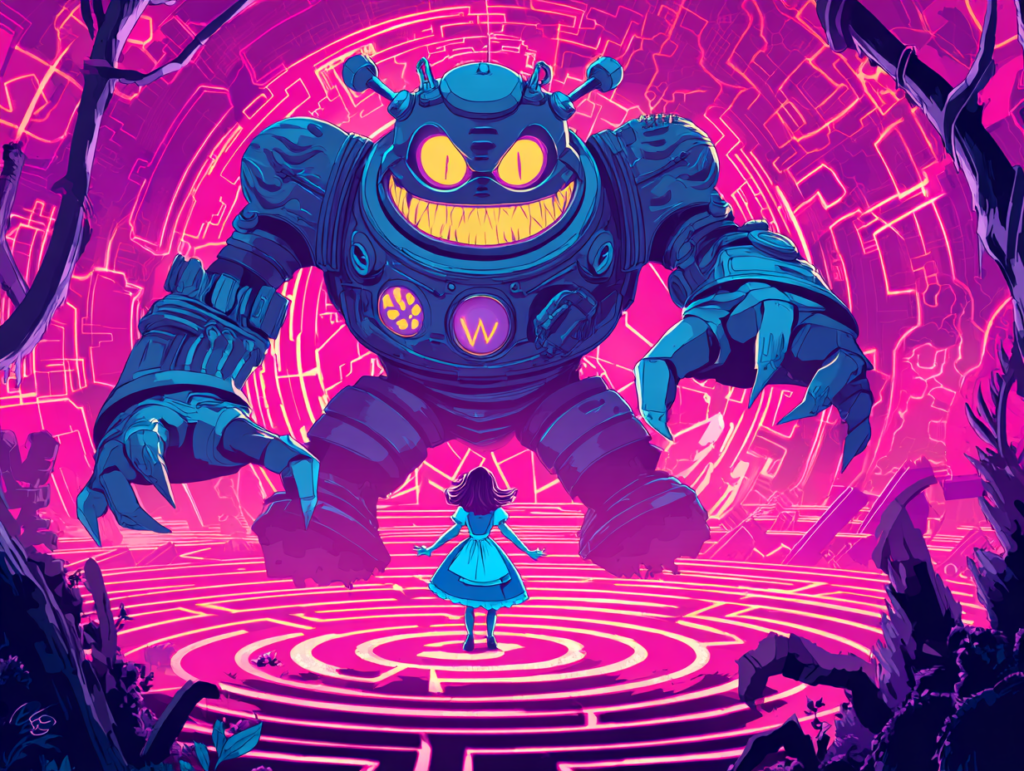
It is important to be clear about what this project is not.
Alice in AI Land is not an argument against artificial intelligence. It does not assume that technology is inherently harmful, nor does it idealize a world without machines. AI can support learning, expand access to information, and reduce unnecessary barriers in many contexts.
The concern here is not presence, but placement.
Technologies do not affect everyone in the same way at every stage of life. What empowers an adult may disorient a child. What feels like assistance to one person may quietly replace an essential developmental process for another.
This project does not advocate rejection or fear. It advocates sequencing.
Understanding should come before optimization.
Orientation should come before acceleration.
Children do not need to be shielded from every complex system. But they do need time to develop the internal tools required to interpret complexity — patience, frustration tolerance, judgment, and the ability to sit with uncertainty.
AI enters learning environments with confidence and fluency built in. That is not a flaw. But fluency can be mistaken for understanding, especially by those still learning how authority works.
The Alice perspective does not ask whether AI should exist.
It asks when, how, and in what role it enters childhood.
This distinction matters. It keeps the conversation grounded, and it allows for thoughtful use rather than reactionary extremes.
Why Stories Come Before Courses
Before people can apply ideas, they need language.
Before they can make decisions, they need orientation.
That is why this project begins with essays and stories rather than instructions or curricula.
Courses are useful when people already share a frame of reference. Stories are useful when they do not.
A story can hold ambiguity without resolving it too quickly. It can surface emotional truths without forcing conclusions. It allows readers — and listeners — to recognize themselves in a situation before they are asked to evaluate it.
The Alice story functions in this way. Not as a lesson, and not as a warning, but as a shared space where questions can exist without immediate answers. It gives parents, educators, and children a common reference point — a way to talk about what feels strange, confusing, or subtly different about growing up with intelligent systems.
Only after that shared language exists does structured learning make sense.
The course that will grow from this project is not meant to replace thinking with guidelines. It is meant to support thinking that has already begun — to give shape to concerns people already feel but struggle to articulate.
In that sense, the story is not promotional material for the course.
It is a prerequisite.
An Invitation to Notice
Alice in AI Land does not tell you where to go.
It asks you to notice where you are.
It invites a slower kind of attention — one that looks at environments rather than isolated tools, at development rather than outcomes, and at orientation rather than optimization.
You do not need to adopt a position to engage with this work. You do not need to agree with every concern or interpretation. What matters is the act of noticing — of pausing long enough to ask how intelligent systems are shaping childhood before those shapes harden into defaults.
Alice does not solve Wonderland.
She survives it by paying attention.
This project exists for a similar reason: not to offer certainty, but to help adults remain present and thoughtful as children grow up inside systems that feel increasingly confident, responsive, and invisible.
If that perspective resonates, you are already inside the conversation.
Frequently Asked Questions
What is Alice in AI Land?
Alice in AI Land is a metaphorical lens for understanding what it feels like to grow up alongside artificial intelligence. Rather than explaining AI technically, it explores how intelligent systems quietly reshape learning, attention, and development—especially for children.
The project focuses on orientation and perspective, not rules or fear-based warnings.
Is Alice in AI Land against artificial intelligence?
No. Alice in AI Land is not anti-AI.
It does not argue that artificial intelligence is inherently harmful or that it should be rejected. Instead, it asks how, when, and in what role AI enters childhood. The focus is on sequencing, context, and developmental timing—not prohibition.
Why use Alice as a metaphor?
Alice is used because metaphors help humans understand unfamiliar environments without exaggeration or panic.
Growing up with AI can feel disorienting in subtle ways: rules are unclear, authority feels confident but opaque, and answers arrive instantly. The Alice metaphor allows these experiences to be discussed calmly, without turning them into dystopian or utopian claims.
What is the “Alice perspective” or “Alice framework”?
The Alice perspective (sometimes loosely called the Alice framework) is not a rigid system or set of rules.
It refers to a recurring way of noticing how intelligent environments shape understanding—especially before beliefs fully form. It emphasizes attention, orientation, and internal maps rather than optimization or performance.
How does AI affect children differently than adults?
Children are still forming internal maps of how the world works.
Adults usually have prior experience with confusion, delay, and effort, which helps them interpret intelligent systems. Children, however, may treat fluent, confident AI responses as a baseline for learning. This can quietly compress the space between not knowing and understanding.
The concern is not intelligence, but orientation.
Is confusion bad for children?
No. Confusion is essential for learning.
What matters is how confusion is experienced. Productive confusion includes struggle, feedback, and resolution. Ambient confusion—where systems work but cannot be questioned or understood—can be harder for children to interpret before they have tools for judgment and patience.
Why does this project focus on stories instead of rules or guidelines?
Stories create shared language before decisions are made.
Before people can apply frameworks or follow guidelines, they need a way to talk about what they are experiencing. Stories allow ambiguity, emotional recognition, and reflection—making them a natural starting point before courses or structured learning.
Is this a parenting guide or an education curriculum?
No. Alice in AI Land is not a how-to guide or a curriculum.
It is a reflective project designed to help parents, educators, and readers notice patterns, ask better questions, and remain attentive as intelligent systems become part of childhood environments.
Will there be a course or educational material?
Yes, a course will grow out of this project.
However, the course is designed to support thinking that has already begun—not replace it with instructions. The essays and stories come first to establish shared orientation before any structured material is introduced.
Who is Alice in AI Land for?
This project is for parents, educators, and anyone interested in how AI reshapes childhood, learning, and development.
It is especially relevant for readers who feel that existing discussions about AI are either too technical, too alarmist, or too superficial.
Do I need to agree with everything to engage with this project?
No.
Alice in AI Land does not require agreement or ideological alignment. It invites attention, reflection, and curiosity. If the perspective helps you notice something new, it has done its work.