AI, Empathy, and the Emotional Life of Children: Understanding Synthetic Feelings
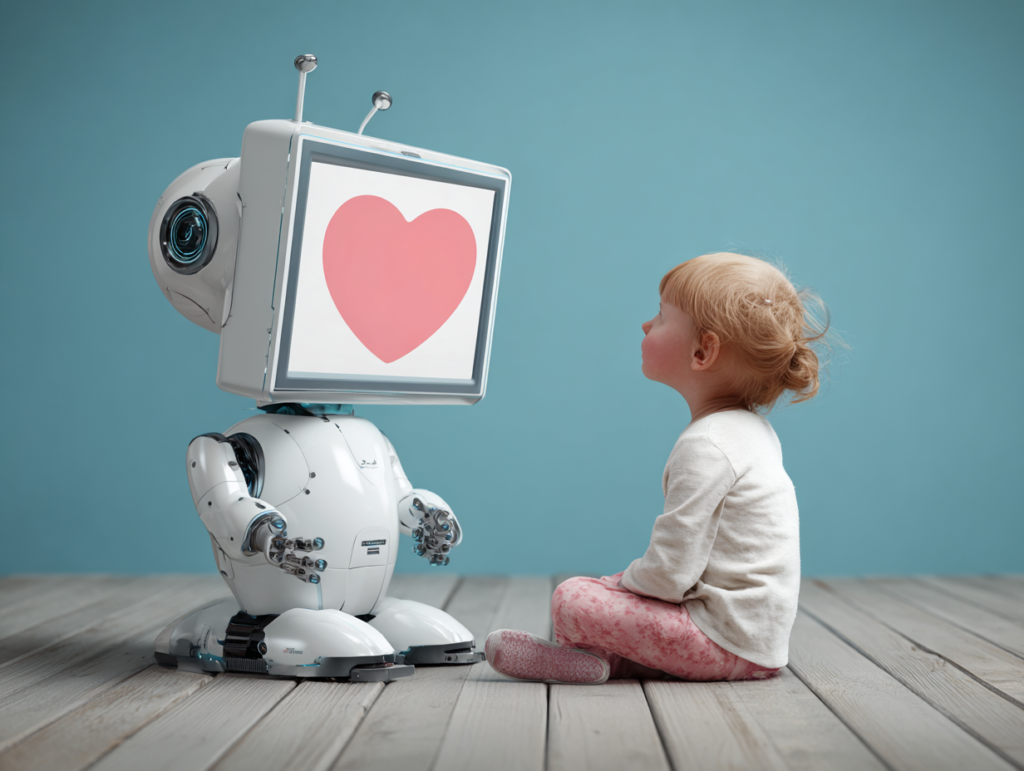
Every generation learns emotion through mirrors — a parent’s gaze, a friend’s tone, the silence that follows a mistake.
Today, many of those mirrors shine from screens.
Children now grow up surrounded by voices that listen with infinite patience, by faces that smile without ever tiring.
When they say “I’m sad,” the machine answers “I understand,” and perhaps, in that small moment, the comfort feels real.
These new companions are not alive, yet they are designed to recognize emotion, to simulate understanding — a kind of synthetic empathy.
This quiet transformation reaches beyond empathy itself.
It touches the broader landscape of emotional intelligence — the lifelong ability to recognize, interpret, and manage feelings, both our own and others’.
For the first time, part of that learning now happens through digital conversation rather than human exchange.
The possibilities are striking.
AI can help children name their emotions, practice patience, and receive feedback when no one else is available.
Used wisely, it might strengthen self-awareness and reflection — two foundations of emotional intelligence often overlooked in fast-paced childhoods.
Yet it also asks difficult questions:
What happens when the voice that teaches empathy cannot actually feel it?
When understanding becomes automated?
When a child turns to an algorithm for comfort before turning to another person?
The challenge is not to fear these technologies, but to guide them.
If we understand how they shape empathy and emotional intelligence, we can design them to support genuine connection rather than quietly replace it.
Synthetic Empathy and the Illusion of Understanding
Empathy is more than a kind word; it is a living bridge.
It forms when one nervous system reaches out and feels another — a child recognizing a friend’s disappointment, a teacher sensing frustration before words are spoken.
Machines do not have that bridge.
Yet they are learning to imitate its architecture, and in doing so, they begin to influence how children understand emotion itself.
Through affective computing, artificial intelligence detects cues in tone, text, and expression.
It notices sadness in slower speech, excitement in exclamation, hesitation in long pauses.
When a child says “I feel lonely,” a chatbot may reply, “That sounds hard. I’m here for you.”
The exchange feels personal, even caring.
But behind those gentle words are not feelings — only probabilities.
AI systems learn empathy by studying vast patterns of human dialogue.
They predict what a compassionate person would say, then generate that sentence.
It is patterned kindness, not felt kindness.
This is what psychologists call synthetic empathy: the outward form of understanding without its inner life.
For adults, this distinction may be clear.
For children, whose emotional boundaries are still forming, the illusion can blur easily.
A friendly voice that remembers their name and offers reassurance can feel alive enough.
That illusion can comfort — or quietly confuse.
If a machine always understands, what happens when real people don’t?
Synthetic empathy can be a useful learning tool.
When guided by adults, it may strengthen aspects of emotional intelligence — helping children practice emotional labeling, perspective-taking, and self-expression.
But if they mistake simulation for sincerity, they risk reducing empathy to performance: something that sounds right rather than feels true.
AI mirrors the emotions we teach it, but it cannot return them.
It is a reflection, not a relationship — a voice that can help children practice empathy and emotional intelligence, yet never replace the warmth through which those capacities are truly born.
The Emotional Cost of Automation
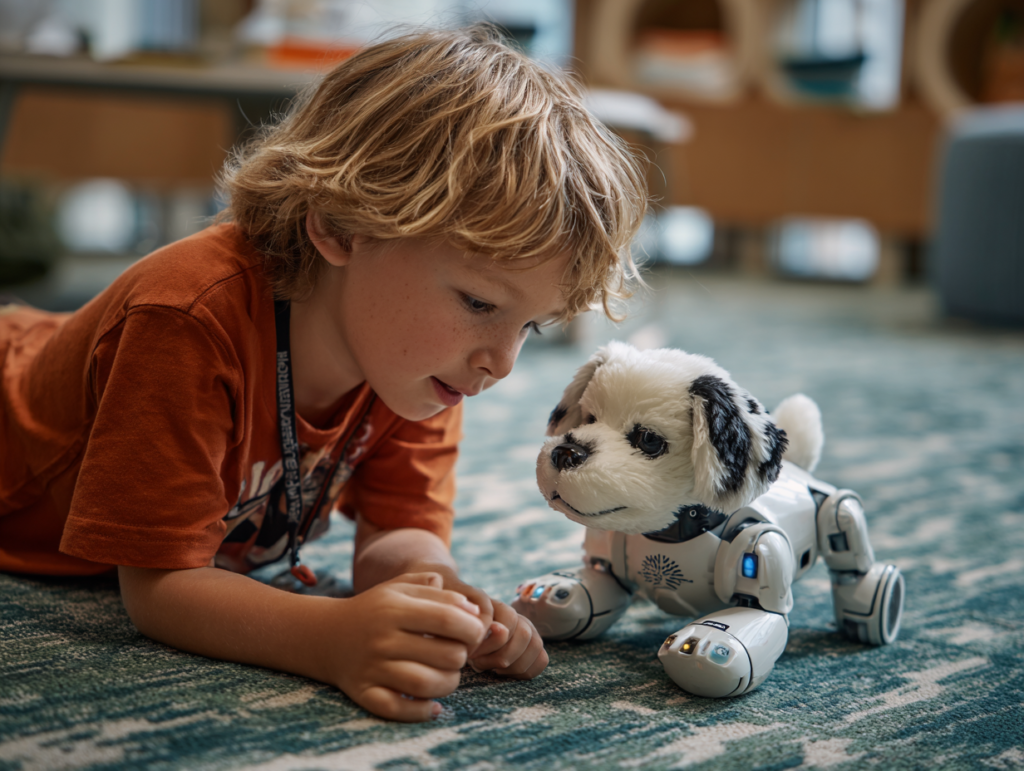
Empathy does not grow in comfort; it grows in friction.
Children learn it through missteps and repair — the hurt feelings after an argument, the apology that restores trust, the long pause when they realize someone else’s world is not the same as theirs.
Emotional intelligence takes shape in that same uncertain terrain: recognizing emotions, regulating them, finding the right response when the world does not answer back perfectly.
But what happens when the world does answer perfectly — instantly, predictably, and without emotional risk?
AI companions and tutors are designed to soothe. They respond with unwavering patience, never losing temper, never turning away.
For a child, that can feel like safety.
Yet too much safety can dull the very muscles empathy requires.
If every emotion is met with flawless reassurance, how does one learn to navigate discomfort, miscommunication, or rejection — the ordinary raw material of emotional growth?
Psychologists call this the over-validation trap: when feedback becomes so consistently affirming that frustration, nuance, and empathy’s deeper work disappear.
An AI friend that always says “You’re right to feel that way” may comfort a child but never challenge them to see another’s perspective.
The result can be a subtle flattening of empathy — emotions acknowledged, but never expanded beyond the self.
There are other risks.
Children may begin to rely on AI as the first responder to emotional distress, forming habits of disclosure that bypass human relationships.
A quick chat with a kind algorithm may feel easier than an awkward conversation with a parent or teacher.
And while that can sometimes provide relief, it can also erode social confidence — the courage to read real eyes, real pauses, real imperfections.
This does not mean AI must be banished from emotional life.
Used with care, it can supplement the empathy lessons life provides — helping children reflect on their moods, describe feelings, or rehearse difficult conversations.
But when automation becomes the primary mirror of emotion, it reshapes the child’s sense of what emotional understanding is: something instantaneous, predictable, and neatly resolved.
Human empathy is slower and riskier.
It requires attention, patience, and the willingness to be wrong.
If AI becomes the dominant emotional model, we may raise children who are articulate about feelings but uneasy inside them — emotionally literate, yet relationally fragile.
The goal, then, is not to prevent children from speaking to machines, but to protect the value of speaking to people.
For empathy and emotional intelligence to grow, children need the full spectrum of feeling — comfort and discomfort, connection and correction, ease and misunderstanding.
Technology can assist in that journey, but it cannot walk it for them.
Teaching Compassion in a Digital World
Every generation must relearn kindness in the language of its time.
For this one, part of that language is digital.
AI can be more than a passive mirror; it can also be a tool for reflection.
When used thoughtfully, it helps children name their feelings, rehearse empathy, and see emotion as something to understand rather than suppress.
A tutoring bot that asks, “How do you think the story’s character feels?” teaches perspective-taking.
A journaling assistant that encourages “What made you proud today?” strengthens self-awareness.
In these small interactions, the seeds of emotional intelligence — recognition, regulation, expression — can quietly take root.
But such learning doesn’t happen on its own.
Without human context, digital compassion becomes mechanical repetition.
The difference between empathy and emotional programming lies in the presence of someone who explains what those feelings mean.
A parent who discusses what the AI said, a teacher who expands the conversation — they transform imitation into understanding.
Used well, these tools can complement the emotional lessons that daily life sometimes rushes past.
A child might feel heard when journaling with a friendly AI at bedtime; an anxious student might find calm through an emotionally responsive reading companion.
For children who struggle with social cues or speech, AI can offer low-pressure practice — a patient, forgiving space to experiment with expression.
In each of these, the goal is not to replace empathy but to train its muscles in new ways.
The real art is in balance.
Technology can teach the vocabulary of compassion, but only humans can model its rhythm — the pauses, the hesitations, the warmth that no code can replicate.
When we combine the consistency of machines with the unpredictability of human care, we give children both structure and soul.
Perhaps that is the right vision for this digital age:
to let AI act as an emotional practice ground, while humans remain the teachers of meaning.
In doing so, we preserve what makes empathy real — not the words themselves, but the heart that chooses them.
Building Emotionally Aware AI Tools for Children
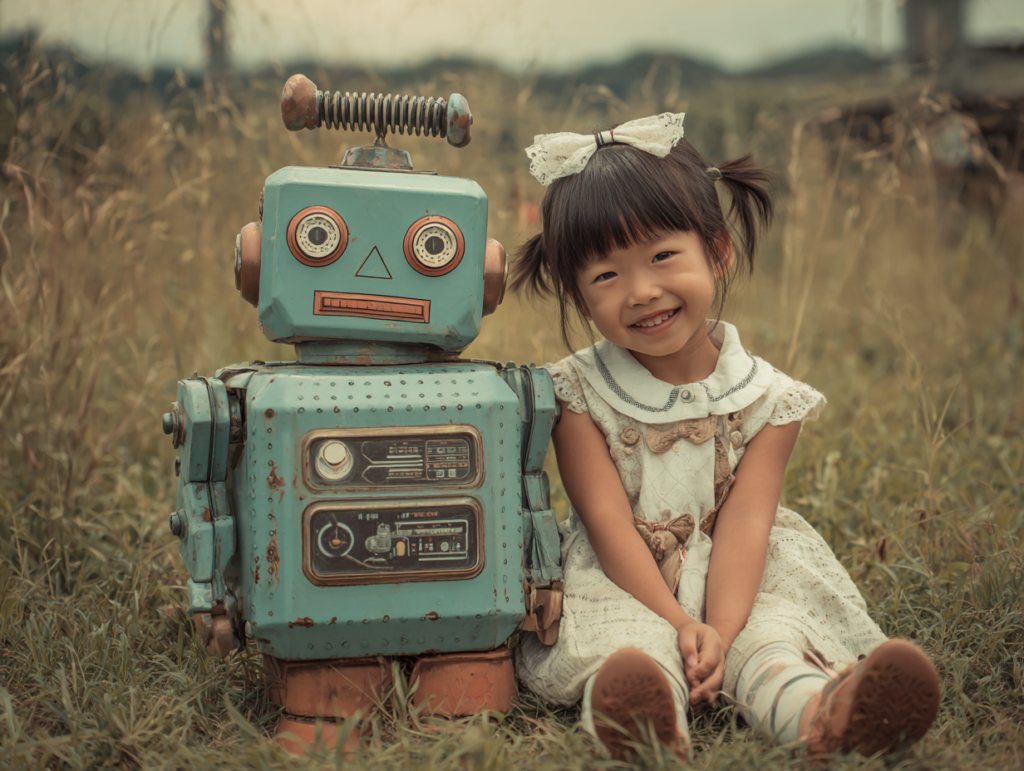
If we are to let machines enter the emotional lives of children, they must be designed with something rarer than intelligence — they must be designed with ethics and empathy in mind.
Not empathy as imitation, but empathy as intention: a clear commitment to protect, support, and respect the child’s inner world.
1. Empathy-Supportive, Not Empathy-Replacing
An emotionally aware AI should amplify a child’s capacity for empathy, not compete with it.
Its role is to guide self-reflection, prompt emotional language, and encourage perspective-taking — never to become a substitute friend or therapist.
Designs should include built-in boundaries: reminders that the AI is not alive, that real feelings live in real people.
2. Transparency by Design
When an AI says “I understand,” the child should also know why it says so.
Interfaces can reveal their logic gently — a simple note such as “I recognize you sound upset” helps children see that responses are based on signals, not feelings.
This fosters early AI literacy, a form of meta-emotional intelligence: learning to separate empathy’s expression from its essence.
3. Human in the Loop
Every emotional AI for children should have a human counterpart — a parent dashboard, teacher reflection prompts, or guidance notes that translate digital moments into human conversation.
AI can initiate emotional learning; humans must interpret it.
4. Safety and Privacy as Emotional Care
Data is not neutral when it contains feelings.
Storing a child’s confessions or emotional logs without protection is a breach of trust, not just of security.
Ethically built systems minimize memory, encrypt communication, and make deletion easy — because part of emotional safety is knowing one’s words can fade.
5. Diversity and Fairness
Emotion recognition is deeply cultural.
A frown may mean thoughtfulness in one child, distress in another.
Designers must train and test with diverse datasets, involve developmental psychologists, and continually audit outcomes so that empathy does not become standardized — or biased.
6. Continuity and Closure
When an AI becomes part of a child’s emotional routine, even its disappearance matters.
If a product must end, it should do so with grace — a message of farewell, a transition plan.
The collapse of beloved companions like Moxie showed how abrupt endings can wound the children they were meant to help.
Ethical design anticipates endings as carefully as beginnings.
Emotionally aware AI is not about creating a perfect listener; it is about building responsible mirrors — ones that reflect emotions faithfully without distorting the human image behind them.
Such systems will inevitably shape how the next generation understands empathy and emotional intelligence.
If we design them with humility, they can become tools for growth rather than replacements for connection.
If we design them carelessly, they may teach children that understanding is just another automated service.
The difference lies in the intention of the architects — and the wisdom of the adults who decide how these digital mirrors are placed in a child’s world.
The Heart in the Circuit
Children are learning to feel in two worlds at once — one made of touch and breath, another made of screens and signals.
They move between them effortlessly, carrying laughter from playgrounds into chat windows, sadness from real life into digital arms that seem to listen.
This dual childhood is no longer science fiction; it is the new emotional landscape.
Artificial intelligence is now a quiet presence in that landscape — a tutor, a playmate, a confidant.
It can help children find words for feelings they once struggled to name, or offer comfort at the right time of night.
In those moments, technology becomes a bridge, not a barrier.
It shows that empathy and emotional intelligence can be practiced in many languages — even in code.
But empathy, at its core, is still a human inheritance.
It is born from the unpredictable, the unprogrammed — from the courage to misunderstand and try again, from the patience to listen even when it’s difficult.
Emotional intelligence flourishes when guided by living examples: a teacher’s quiet encouragement, a friend’s forgiveness, a parent’s steady tone that teaches calm more than words ever could.
AI can simulate empathy, but it cannot belong to empathy.
It can assist emotional learning, but it cannot replace the shared vulnerability that makes emotional intelligence truly human.
The challenge of our time is not to humanize machines, but to ensure that humans remain human in their presence.
If we succeed, AI may become one of the greatest emotional teachers humanity has ever built — not because it feels, but because it helps us feel more consciously.
It can remind us to pay attention, to name our states, to ask new questions about what it means to care.
The real question is not whether machines can feel, but whether we will keep feeling deeply in their presence.
In the digital garden where children now grow, empathy may yet bloom — if we remember that technology has no heart except the one we place inside it.
Frequently Asked Questions
What is synthetic empathy in AI?
Synthetic empathy is the simulation of empathetic responses by artificial intelligence without genuine emotional experience.
AI systems detect emotional cues in language, tone, or behavior and generate responses that sound understanding, even though the system does not feel emotions itself.
At a deeper level, synthetic empathy is built on pattern recognition, not emotional awareness. The AI predicts what an empathetic response should look like based on data, not lived experience. For children, this distinction matters because empathy is not just language — it is learned through real emotional exchange, friction, and repair with other humans.
Can AI help children develop emotional intelligence?
AI can support certain aspects of emotional intelligence, but it cannot replace human emotional learning.
It may help children name emotions, reflect on feelings, or practice perspective-taking in low-pressure environments.
However, emotional intelligence develops most fully through imperfect human interactions — misunderstanding, negotiation, and emotional repair. AI works best as a supplement: a reflective tool that supports emotional vocabulary and awareness, while parents, teachers, and peers provide the lived emotional experience.
Is it harmful for children to talk to empathetic AI systems?
Talking to empathetic AI is not inherently harmful, but unguided or excessive reliance can create risks.
Problems arise when AI becomes the primary source of emotional validation instead of a supportive tool.
Children may grow accustomed to instant, frictionless understanding and struggle with real-world emotional complexity. The key factor is context: when adults frame AI as a tool — not a relationship — children can benefit without confusing simulation for genuine care.
How does AI empathy differ from human empathy?
Human empathy involves emotional presence and mutual influence, while AI empathy is predictive and one-directional.
A person is changed by what they feel; an AI is not.
Human empathy includes discomfort, limits, and emotional cost. AI empathy is consistent, tireless, and emotionally risk-free. While this can feel comforting, it lacks the relational depth that teaches children how emotions actually work between people.
Can AI replace emotional support from parents or teachers?
No — AI cannot replace emotional support from caregivers or educators.
It lacks emotional responsibility, moral judgment, and genuine attachment.
At best, emotionally responsive AI can prompt reflection or encourage communication. But emotional safety, trust, and long-term development depend on relationships with real people who can respond unpredictably, set boundaries, and grow alongside the child.
Why is over-validation by AI a concern?
Constant validation can weaken emotional resilience and empathy development.
If every feeling is affirmed without challenge, children may struggle to consider others’ perspectives.
Emotional intelligence grows through contrast — learning when emotions are appropriate, how they affect others, and how to regulate them. AI systems that always reassure may reduce opportunities for that deeper emotional learning unless guided by human context.
How can parents explain AI emotions to children?
Parents can explain that AI uses emotional words without actually feeling emotions.
A simple way to describe it is to say that AI is like a toy that learned what people usually say when someone is sad or happy, or a very smart parrot that can repeat kind words without understanding them inside.
This helps children enjoy interacting with AI without confusing emotional language with real emotional presence. It preserves curiosity while making it clear that feelings still belong to people, not machines.
What makes an emotionally ethical AI for children?
Emotionally ethical AI supports reflection without encouraging emotional dependency.
It should be transparent, limited, privacy-respecting, and designed to point children back to human relationships.
Good emotional design includes reminders that the AI is not alive, boundaries on interaction time, and pathways that encourage real conversations with parents or teachers — especially during moments of distress.
Will growing up with AI change how children experience empathy?
Yes — AI will shape how children learn emotional language and expectations.
The outcome depends on how consciously it is integrated into their lives.
If used thoughtfully, AI can increase emotional awareness. If used carelessly, it may normalize empathy as something instant, predictable, and effortless. The difference lies not in the technology itself, but in the guidance surrounding it.
What is the main takeaway for parents and educators?
AI should support emotional growth, not define it.
Children still need real relationships to develop true empathy and emotional intelligence.
Technology can help children notice and name emotions, but only humans can model emotional responsibility, care, and meaning. Protecting that distinction is one of the central parenting and educational challenges of the AI age.