AI and Children’s Creativity: Imagination in the Machine Age
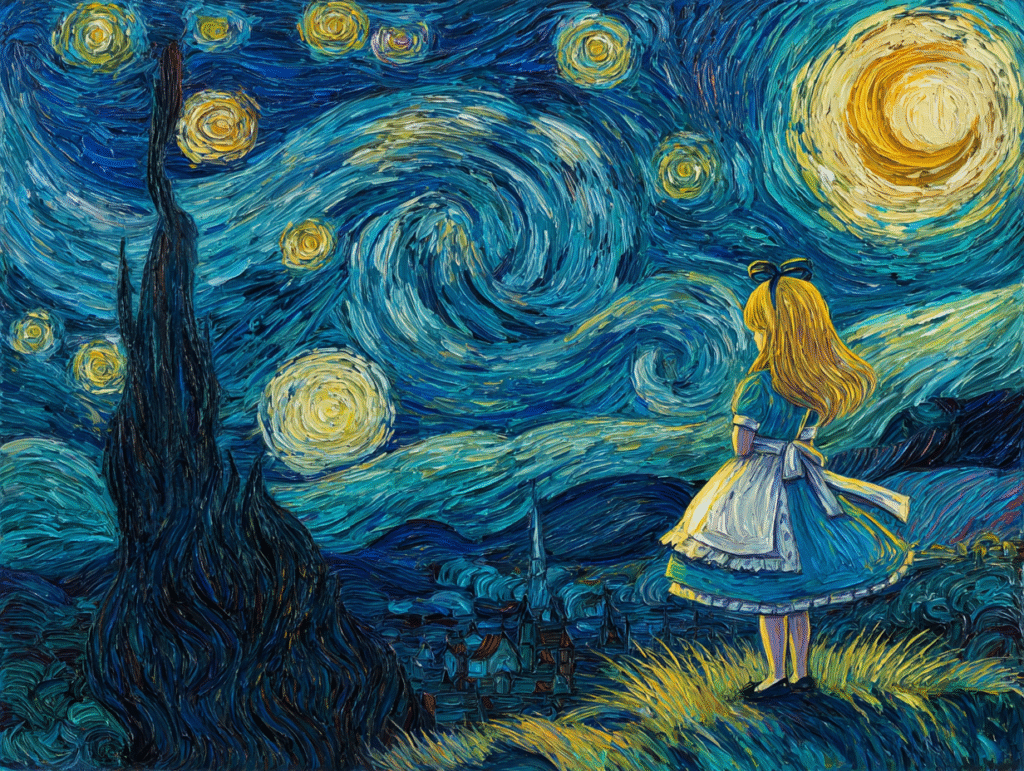
Every child’s first invention is play. A cardboard box becomes a spaceship; a stick becomes a magic wand. Imagination is not just entertainment for children — it’s how they test the boundaries of possibility, build confidence, and discover their own voices.
But what happens when artificial intelligence becomes their playmate?
Already, AI is slipping into the creative corners of childhood. A six-year-old in India uses an app to turn her bedtime ideas into illustrated storybooks. A fourth grader in Australia compares her monster drawing to one conjured up by DALL·E, deciding which version she likes best. A child in Ohio spends two hours chatting with ChatGPT, convinced it’s the most fascinating train-loving “friend” he’s ever met. Even toys — plush robots like Geni or Moxie — now promise to remember children’s preferences and join them in imaginative play.
For the first time, children are not just consuming stories and games — they are co-creating them with machines.
This is both thrilling and unsettling. On one hand, AI can give children tools they never had before: drawing without drawing skills, storytelling without spelling, whole imaginary worlds spun up at the speed of thought. On the other hand, it raises questions: Will children lean on AI so heavily that they lose the practice of inventing for themselves? Will their creativity shrink into the stereotypes that AI reflects? Will they confuse a talking toy for a real friend?
At Alice in AI Land, we see these questions through a familiar lens. Like Alice stepping into Wonderland, today’s children walk into a strange new land of possibilities and risks. The Mad Hatter’s tea party dazzles with joyful chaos. The Cheshire Cat smiles from the shadows, hinting at hidden dangers. The Red Queen races ahead, threatening to turn play into a frantic chase.
Our journey in this article is to explore how AI is reshaping children’s creativity — in art, in storytelling, in play — and what promises and perils lie along the way.
The Promise of AI for Creativity
AI is not only reshaping how adults work — it is transforming how children imagine. At its best, AI can be a creative catalyst: a spark that helps children explore ideas they couldn’t execute alone, a companion that never runs out of stories, a tool that brings dreams into tangible form.
New Canvases
Generative art platforms like Kidgeni and DALL·E allow children to see their wildest ideas illustrated instantly. A child who can’t yet draw beyond stick figures can describe “a panda riding a skateboard at sunset” and watch it appear. In classrooms, teachers have used DALL·E alongside student drawings — letting children compare the AI’s output with their own. For many, this isn’t discouraging but inspiring: “My dragon has feathers in the AI picture — maybe mine is half-bird!” Kids who normally shy away from drawing sometimes jump in, excited by what AI reveals.
Storytelling Partners
Storytelling has always been central to childhood. Now, AI can act as a co-author. A six-year-old can dictate a few words — “a princess, a flying elephant, and a rainbow island” — and apps like StoryWizard or ChatGPT will spin it into a bedtime tale. Parents report that children often add their own twists mid-story, learning that imagination is not fixed but expandable. In some cases, the AI even serves as a character — a “talking astronaut” in a child’s play session — creating interactive, dynamic stories that stretch as far as curiosity goes.
Interactive Playmates
Beyond screens, AI is moving into toys and robots that join children’s make-believe worlds. Plush companions like Grok or social robots like Moxie remember children’s preferences, suggest new play scenarios, or co-create characters in imaginary games. Instead of passively watching a cartoon, a child can have an AI toy role-play in their pretend restaurant or pirate ship. When designed well, these interactions reduce screen time and bring technology back into physical play, blurring the boundary between toy and co-creator.
Accessibility for All
One of AI’s most exciting promises is its ability to make creativity open to every child. A child with dyslexia can tell a story aloud and see it typed and illustrated. A child with limited motor skills can use voice prompts to generate drawings. AI adapts to different learning styles and speeds, helping each child express their imagination in ways that feel natural to them. Creativity isn’t reserved for a select few — with the right tools, every child can turn their ideas into something visible and shareable.
The Wonderland Metaphor
If education is the White Rabbit’s clock (structured and measured), then creativity is the Mad Hatter’s Tea Party — delightful, chaotic, and endlessly surprising. AI fits here as both host and guest: pouring new ideas, reshaping the table, encouraging children to see the world upside down.
When used with care, AI does not replace a child’s imagination — it amplifies it, giving them tools that expand the horizon of what’s possible.
The Risks of AI for Creativity

If AI can act like the Mad Hatter, serving endless ideas at the table, it can also become the Red Queen — rushing children forward but leaving them creatively stagnant. The very tools that inspire can also narrow imagination if not guided carefully.
Over-Reliance and Shallow Creativity
When AI provides quick solutions, children may lean on it instead of working through creative struggles. UNESCO warns that generative AI can lead to “formulaic outcomes” if used without care, limiting originality. A child who always asks an AI to finish a story or draw an image may stop practicing the skills of imagining, drafting, or refining — muscles that need exercise to grow.
Homogenization and Bias
AI outputs are shaped by the data they’re trained on. That means children may see stereotypical patterns repeated: doctors always male, princesses always white, leaders always Western. Over time, this could steer their creative worlds into narrow lanes. Research also suggests AI content tends to homogenize, reducing diversity in stories and ideas. Creativity thrives on variety — but AI’s averages may smooth out the very rough edges that spark originality.
Loss of Practice
Creativity is messy: a doodle that becomes a dragon, a story draft that twists into something surprising. If AI always supplies polished outputs, children risk losing the trial-and-error process that fuels imagination. Drawing, revising, and even getting bored are vital steps. Without them, children might learn to consume creativity rather than generate it.
Blurred Reality
Young children often blur the line between real and pretend — and AI blurs it further. A four-year-old once insisted that a monster truck created by AI was real. Some kids describe AI as “like a fairy,” or treat talking assistants as friends. This can make AI play enchanting, but also risky: children may trust AI as if it were human, giving it more influence than intended.
Exposure Risks
Not all AI systems are built for kids. Without strict guardrails, children might encounter inappropriate, frightening, or biased content. Even when platforms are designed for younger audiences, parents and educators must remain vigilant — ensuring that AI stays in the realm of imagination and inspiration, not confusion or harm.
Metaphor: If the promise of AI is the Mad Hatter’s joyful chaos, the risk is the Red Queen’s race — running faster and faster, but going nowhere new. Without care, AI can flood children with outputs that feel magical in the moment but hollow in the long run.
Guiding Children’s Creative Use of AI
AI doesn’t have to be a thief of imagination. With thoughtful guidance, it can be a springboard — helping children dream bigger while still building their own creative muscles. The key is balance: using AI as a partner, not a replacement.
Parents: Co-Creators and Question Askers
Parents don’t need to be AI experts to guide creative play. What matters most is sharing the process:
- Sit with your child while they use a story app or art tool.
- Ask questions like “What part of this was your idea?” or “How would you change the AI’s picture?”
- Encourage them to add their own twist rather than taking AI’s output as the final answer.
This shows children that AI is just one ingredient — their imagination is the recipe.
Teachers: Turning Tools into Lessons
In classrooms, teachers can frame AI as a creative catalyst. For example:
- Have students compare their own drawings with an AI’s version, then discuss what they like or dislike.
- Let AI suggest a plot twist, then challenge the class to improve on it.
- Highlight biases (“Why does the AI make all the doctors male?” or “Why are the princesses always white?”) as teachable moments.
By guiding AI use, teachers can strengthen not just creativity, but also media literacy and critical thinking.
Balancing Time In and Out of Wonderland
Boredom is not the enemy of creativity — it’s the soil it grows in. Children need space away from AI to doodle, daydream, and invent without prompts. Setting limits (e.g., “let’s do one AI story, then one without it”) ensures imagination develops both with and without digital help.
Critical Skills: Inspiration vs. Imitation
AI can provide endless suggestions, but children should learn to treat these as starting points, not scripts. Encourage them to remix, reject, or expand AI’s ideas — just like they might argue with a friend during play. This develops confidence and teaches them that originality lies in what they contribute, not what the machine outputs.
Metaphor: Like the White Rabbit’s clock, guidance reminds us that time in Wonderland should be balanced with time in the real world. AI can make play brighter, but only adults can ensure children don’t get lost in its glow.
Global and Ethical Dimension of Creative AI
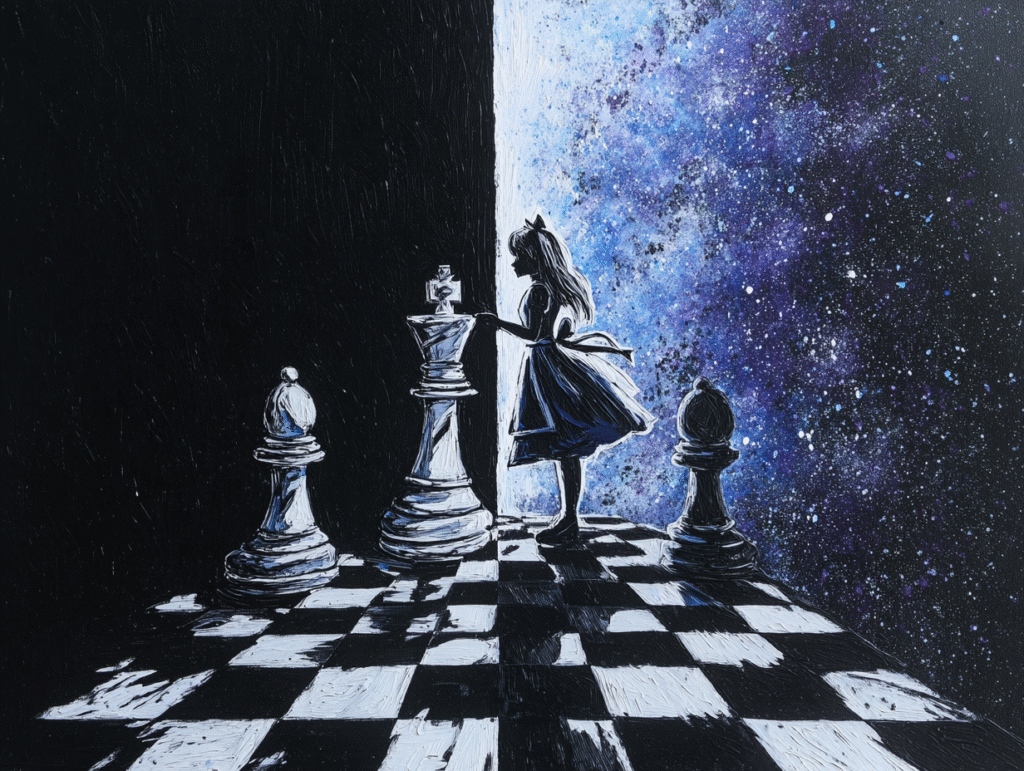
Children’s creativity does not unfold in a vacuum. It is shaped by the tools they use, the cultures they live in, and the systems that govern access. AI adds another layer: while it can democratize creativity, it can also deepen divides and reinforce biases if not handled with care.
Equity: Who Gets Access?
In some homes, children use AI to co-write stories or generate art with a few taps. In others, schools still lack internet or even electricity. Without deliberate investment, AI risks widening the creative gap between privileged children and those in under-resourced communities. A global child should not miss out on modern tools simply because of geography or income.
Culture and Diversity
AI reflects the data it learns from — which often skews toward Western, English-language, and mainstream cultural material. This means a child in Brazil or Kenya might see fewer stories rooted in their own traditions, or find their heroes replaced with stereotypes. UNESCO warns that such tools can unintentionally perpetuate cultural bias, flattening diverse narratives into a single dominant voice. Protecting cultural richness is vital: children everywhere deserve to see themselves in the stories and images AI helps create.
Ownership of Children’s Creations
If a child uses an AI tool to illustrate a comic or write a story, who owns the result? Legally, this question remains unsettled. Ethically, though, the answer should be clear: the child’s imagination comes first. Tools must be designed so children feel ownership of what they create — not left wondering whether it “belongs” to the company that built the model.
International Frameworks
UNICEF’s Policy Guidance on AI for Children stresses nine child-centered principles, including protecting privacy, ensuring inclusivity, and supporting development. UNESCO’s AI Competency Frameworks emphasize that AI should enhance, not limit, creativity. These bodies provide a compass for governments and companies alike: keep children’s rights at the heart of design, so creativity remains empowering rather than exploitative.
The Wonderland Lens
Here the Cheshire Cat reappears: smiling, but never fully trustworthy. Its grin promises infinite paths, yet some may vanish if diversity and fairness aren’t actively protected. Global cooperation is what keeps Wonderland open to all children — not just a privileged few.
Responsibility – Keeping Creativity Human
AI can be dazzling, but creativity is still a human birthright. Children’s imagination should not be outsourced or reshaped entirely by algorithms. The responsibility to keep creativity alive is shared — by parents, teachers, companies, and governments.
Parents: The First Guides
Parents shape how children see AI: as a toy, a tool, or a crutch. By sitting alongside their children, co-creating, and asking reflective questions, they remind kids that the magic comes from them. Even small practices — encouraging a child to finish an AI story in their own words, or to redraw an AI image their way — can preserve originality.
Teachers: Guardians of Authenticity
In classrooms, teachers carry the role of compass. They decide when AI enters a lesson, how it’s framed, and whether students understand its limits. Teachers can highlight bias, prompt debates (“Is this story really creative, or just average?”), and ensure that children’s voices stay at the center. AI is the tool; the lesson is still human connection and critical thought.
Companies: Designing for Children, Not Consumers
Companies building creative AI tools for kids have enormous influence. Will they create safe, inclusive, age-appropriate platforms — or products designed to maximize engagement and profit? Following UNICEF’s child-centered AI principles means putting children’s rights before commercial goals: strict content filters, transparency about data, and a focus on sparking imagination rather than trapping attention.
Governments and Policymakers: Setting the Guardrails
Governments set the standards that shape access and fairness. They can fund schools so creative AI is not just for wealthy districts, enforce privacy protections so children’s creations are not exploited, and adopt UNESCO’s global frameworks to ensure AI enhances creativity rather than replacing it. Without these guardrails, the creative divide only grows.
Metaphor: Think of creativity as Alice’s tea party — delightful, playful, a little chaotic. But the party only works when kindness and imagination set the rules. Without guidance, the table descends into nonsense. Responsibility ensures that Wonderland stays a place where every child can dream freely, rather than a maze designed by algorithms alone.
Conclusion – The Future of Play
Children have always invented their own worlds. A stick becomes a sword; a cardboard box becomes a castle. What makes this generation different is that their playmate is no longer just a sibling, a toy, or a pet — it is also a machine that listens, talks, and creates.
AI’s promise is dazzling: it can spark imagination, open doors for children who struggle to express themselves, and bring their ideas to life in vivid new forms. But the risks are equally real: over-reliance, homogenized stories, blurred realities, and a world where only some children get access to the newest creative tools.
The challenge before us is not whether AI will be part of children’s creativity — it already is. The challenge is how we guide it: ensuring AI amplifies imagination instead of shrinking it, reflects diversity instead of bias, and inspires children to play more freely, not more narrowly.
At Alice in AI Land, we believe the true test of this technology is not what AI creates for children, but what it helps children create for themselves.
Because the real magic is not in the algorithm — it is in the child holding the stick, dreaming up a castle, and deciding what Wonderland looks like.
Frequently Asked Questions
How can AI support children’s creativity?
AI can act as a creative catalyst. It helps children turn ideas into stories, drawings, or characters even if they lack the technical skills. Tools like AI storytelling apps, drawing generators, or interactive robots can spark imagination and make creative expression more accessible.
For children with learning differences or disabilities, AI can open new doors — such as voice-to-story systems or adaptive art tools. Rather than replacing imagination, AI can provide the scaffolding to help children explore it more deeply.
What are the main promises of AI for children’s creativity?
The key promises are accessibility, inspiration, and play. AI allows any child to illustrate ideas, co-create stories, and explore new worlds of imaginative play. It can also help children who struggle with reading, writing, or drawing express themselves in new ways.
AI’s potential is not just entertainment — it can nurture confidence, foster inclusion, and show children that their ideas matter, regardless of skill level.
What are the biggest risks of AI in children’s creativity?
The risks include over-reliance on AI outputs, loss of originality, reinforcement of stereotypes, blurred lines between reality and fantasy, and unequal access. AI might encourage shallow creativity if children lean on it instead of practicing their own skills.
UNESCO warns about “formulaic outcomes” from generative AI. Without guidance, children may consume creativity rather than create it, weakening the problem-solving and trial-and-error processes that fuel imagination.
Can AI make children less creative?
AI itself doesn’t “kill” creativity — but without guidance, it can encourage shortcuts. If children always let AI finish stories or make pictures, they may stop practicing creative problem-solving.
The key lies in balance: AI should be a springboard for ideas, not a crutch. Children should be encouraged to adapt, expand, or even reject AI suggestions to build originality.
How does AI affect cultural diversity in children’s creativity?
AI often mirrors the cultural bias in its training data. Many AI models lean toward Western, English-speaking traditions, which means children worldwide may see fewer stories or images that reflect their own cultures.
This risks flattening global diversity. Ensuring diverse datasets and promoting local content creation are essential so that AI celebrates many voices instead of repeating the same ones.
Who owns the creative work children make with AI?
Legally, this is still unresolved. Most copyright laws don’t clearly cover AI-assisted work. But ethically, a child’s imagination should be considered the true source.
Companies should design AI tools so children feel ownership of their creations, rather than letting corporations claim credit or data. Parents and educators can reinforce this by celebrating the child’s input as the heart of the work.
How can parents guide children’s creative use of AI?
Parents can join the process: ask children reflective questions, encourage them to add personal touches, and balance time with and without AI tools. This ensures children see AI as a helper, not a replacement.
Examples include asking, “Which part did you imagine?” or “How would you change the AI’s picture?” Such prompts help children think critically and keep their own imagination central.
How should teachers integrate AI into creative learning?
Teachers can use AI as a teaching tool rather than a final solution. Comparing student work with AI outputs, critiquing biases, and using AI to spark discussions helps children develop critical thinking alongside creativity.
Teachers can also use AI for accessibility — helping students with dyslexia, motor challenges, or language barriers participate fully in creative projects.
Why is equal access to AI important for children’s creativity?
Without equal access, AI risks deepening inequality. Children in wealthier homes and schools may grow up fluent in AI tools, while others are left behind.
Governments and organizations like UNICEF stress the importance of closing digital divides. Infrastructure, affordable tools, and inclusive policies are needed so creativity is not a privilege but a right.
What role do UNICEF and UNESCO play in AI and children’s creativity?
UNICEF and UNESCO provide guidelines and policy frameworks to ensure AI supports children’s rights. UNICEF emphasizes inclusion, transparency, and child-centered design. UNESCO highlights the need for diversity, equity, and responsible use in education and creativity.
While these are not binding laws, they act as roadmaps for governments and companies to align AI with children’s welfare.
What ethical challenges come with AI and creativity for children?
The main ethical challenges are inequity, cultural bias, lack of ownership, and commercial exploitation. Companies may design AI to maximize profit rather than nurture imagination.
Ethical AI for children means protecting their privacy, fostering inclusion, and prioritizing developmental benefits over corporate interests.
What is the future of AI and children’s creativity?
AI will likely become a normal part of how children play, learn, and create. The question is not whether children will grow up with AI, but how. The future depends on whether adults — parents, teachers, companies, and governments — guide AI to amplify imagination rather than replace it.
With thoughtful design and policy, AI could help create a generation of children who see technology not as a crutch but as a co-creator in their imaginative journeys.