From Answers to Judgment: Why Thinking Is More Than Information

We live in an age where answers arrive faster than questions can settle.
Children grow up surrounded by search engines, recommendation systems, and now conversational AI that produces explanations instantly—often fluent, confident, and complete-sounding. This environment quietly reshapes what “knowing” feels like. Knowing becomes less about exploration and more about retrieval. Less about thinking through something, more about receiving something finished.
AI did not create this condition. It simply completed it.
Long before large language models, education systems were already drifting toward an information-first model: access to facts, summaries, explanations, and standardized answers. The underlying assumption was simple and rarely stated: if children have access to good information, good thinking will follow.
For a while, this assumption appeared to work. Information was slower, authority was clearer, and errors were easier to detect. A wrong answer often looked wrong. A shallow explanation sounded shallow. Time and effort acted as natural filters.
AI removes those filters.
Today, answers arrive instantly, without friction, and with a level of linguistic confidence that mimics understanding. The result is not that children suddenly stop thinking—but that the boundary between thinking and receiving blurs. The presence of an answer begins to feel like the completion of a cognitive task, even when no real evaluation has occurred.
This is the real shift AI introduces: not the abundance of information, but the illusion of cognitive closure.
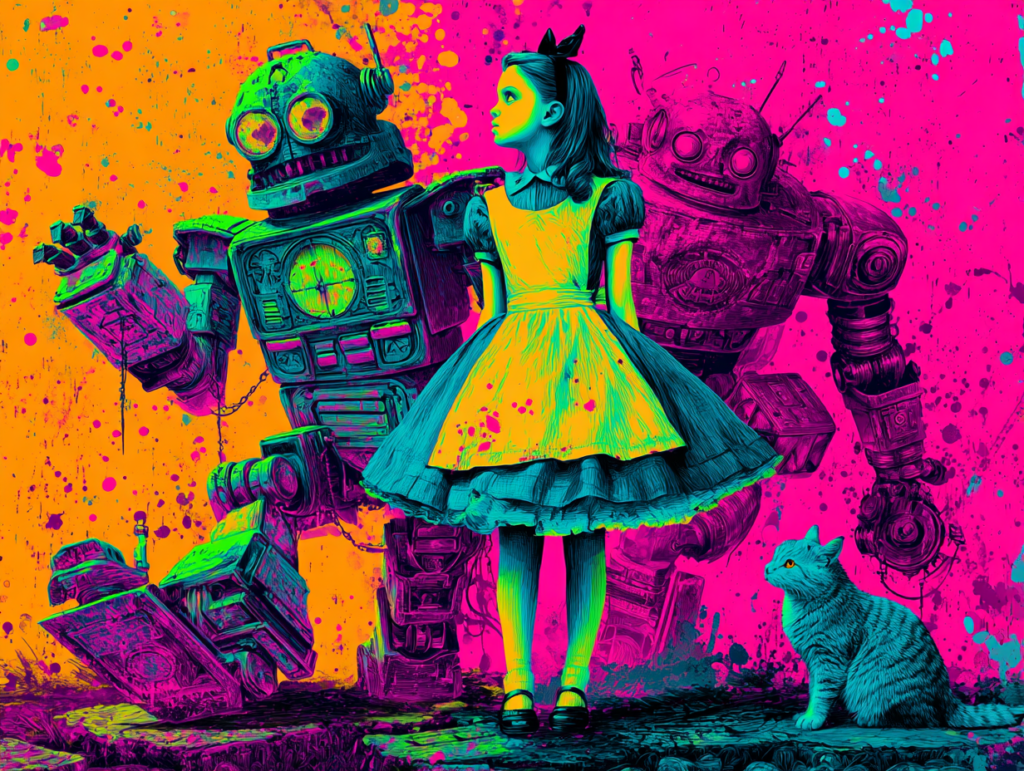
Much like Alice stepping into a hallway in Wonderland where every door is already open, access alone does not make the choice disappear — it only makes the act of choosing easier to overlook.
Why Information Is Not the Same as Thinking
One of the most persistent confusions in modern education is the idea that information and thinking are interchangeable.
They are not.
Information is content: facts, explanations, procedures, descriptions. Thinking is a process: evaluating, comparing, questioning, holding uncertainty, and deciding what weight an idea deserves. A child can possess accurate information and still not be thinking in any meaningful sense.
This distinction matters because information is transferable, but thinking is formed.
Children regularly demonstrate this gap. They can repeat correct answers, summarize explanations, and even sound sophisticated—while remaining unable to explain why something matters, when it applies, or whether it should be trusted. What looks like understanding is often fluent repetition.
AI amplifies this phenomenon.
Because AI-generated answers are well-structured and articulate, they easily create the impression that thinking has already been done. The explanation feels complete. The tone suggests confidence. The language carries authority. For a developing mind, this combination is powerful—and misleading.
Thinking does not mean producing an answer.
Thinking means deciding what an answer is worth.
That decision involves judgment: weighing context, recognizing limits, noticing what is missing, and resisting premature certainty. None of these skills are provided by information alone, no matter how accurate or well-presented it is.
This is why simply giving children “better explanations” or “safer answers” does not solve the deeper problem. The challenge is not informational quality. It is the absence of an internal evaluative layer.
Judgment: The Missing Layer Between Knowledge and Action
If information is what we know, judgment is how we decide what to do with what we know.
This distinction is often overlooked because judgment is quiet. It does not announce itself the way an answer does. It does not arrive fully formed or feel complete. Instead, it shows up as hesitation, comparison, doubt, or restraint — all states that modern education and digital systems tend to interpret as inefficiency.
Judgment is not a fact and not a rule. It is a capacity.
It involves weighing multiple possibilities, sensing context, tolerating ambiguity, and recognizing when certainty is premature. Judgment allows a person to ask not only “Is this correct?” but “Is this appropriate, relevant, sufficient, or wise in this situation?”
This is where the limits of information become visible.
A child can know a fact and still misuse it. They can follow a rule and still cause harm. They can receive a correct answer and still apply it in the wrong context. None of these failures are informational. They are failures of judgment.
AI makes this gap more visible because it produces knowledge without consequence. It can offer plausible explanations, recommendations, and conclusions without having to live with their outcomes. For a developing mind, this creates a subtle but important confusion: answers appear self-contained, as if their correctness alone is enough.
But judgment is never self-contained. It always points beyond the answer to its effects.
In human development, judgment forms at the intersection of knowledge, experience, and responsibility. It grows when a person begins to sense that ideas have weight — that decisions carry consequences beyond correctness. This is why judgment cannot be downloaded, automated, or reliably outsourced. It must be internalized.
In Alice in Wonderland, Alice’s difficulty is not that she lacks information about her surroundings. It is that each new situation demands a different response, and knowing what something is does not tell her how to act within it. The world keeps shifting, and rules that worked moments ago no longer apply.
This is precisely the challenge children face in an AI-rich environment. They are surrounded by answers, but they are still learning how to decide which answers deserve trust, restraint, or rejection. Without judgment, information remains inert — impressive, but incomplete.
Why Judgment Is Developmental (Not Instructional)

One of the most common mistakes in discussions about children, technology, and ethics is the belief that judgment can be taught directly.
It cannot.
Judgment does not emerge from instruction in the way information does. It develops gradually, through a combination of emotional maturation, social experience, and repeated encounters with uncertainty. This is why no amount of rules, warnings, or explanations can substitute for it.
From a developmental perspective, judgment depends on capacities that are still forming throughout childhood and adolescence:
- emotional regulation
- perspective-taking
- impulse control
- identity coherence
- sensitivity to consequence
These capacities are not switched on by exposure to correct answers. They are shaped through time, feedback, and lived experience.
This helps explain a familiar frustration among parents and educators: children may understand explanations perfectly and still make choices that seem obviously unwise. The issue is not comprehension. It is that the internal structures required to weigh information are still under construction.
AI enters the picture at an awkward moment.
Children encounter systems that produce confident, well-structured answers long before their own judgment is stable. The result is a mismatch: external certainty arrives before internal discernment is ready to meet it. This does not mean children are incapable of thinking; it means they are still learning how to hold uncertainty without immediately resolving it.
Instruction tends to collapse uncertainty. Development requires learning to stay with it.
This is why purely instructional responses to AI — rules, guidelines, age gates, or lists of dos and don’ts — feel thin. They operate at the level of behavior while the real work is happening at the level of internal calibration. Judgment forms when children begin to sense why a situation feels different from another, even if they cannot yet articulate it clearly.
In this sense, judgment is closer to balance than to knowledge. It is the ability to remain upright while conditions shift — not because one has memorized the terrain, but because one has learned how to adjust.
In Wonderland, Alice is not handed a stable rulebook. She is forced to adapt to a world where scale changes, authority contradicts itself, and meaning is unstable. Her growth does not come from learning more facts about the place, but from slowly developing the ability to respond without panicking when certainty disappears.
Children navigating AI face a similar challenge. The task is not to protect them from complexity, but to help them grow into it — at a pace their development can support.
AI Gives Answers Without Stakes — Humans Learn Judgment Through Stakes
Judgment does not form in a vacuum. It forms in contact with consequence.
Humans learn to judge by making choices that matter—and by feeling the effects of those choices afterward. Mistakes sting. Misjudgments create friction. Reflection follows discomfort. Over time, these experiences shape an internal sense of proportion: what deserves caution, what invites risk, and when restraint is wiser than action.
This process is slow by design.
AI interrupts it—not by replacing thinking, but by removing stakes.
When an answer comes from AI, nothing is risked. There is no embarrassment for being wrong, no cost for acting too quickly, no emotional signal that something should be reconsidered. The system does not hesitate, doubt, or revise itself in response to consequences it must endure. It produces answers without having to live with them.
For children, this subtly changes the learning environment.
Instead of:
- trying
- failing
- adjusting
they can:
- ask
- receive
- move on
The loop closes too quickly. Reflection is skipped, not because children are unwilling, but because the environment no longer demands it.
This is where the real concern lies. Not in incorrect information, but in premature resolution. When answers arrive without resistance, they feel complete—even when they are contextually fragile or morally unfinished.
Human judgment, by contrast, matures through friction. It depends on moments where the right response is unclear, where multiple options compete, and where choosing one path excludes another. These moments create internal tension. That tension is not a flaw; it is the training ground of discernment.
AI smooths those moments away.
This does not mean children should be denied AI tools. It means adults must recognize what AI cannot provide: the experience of carrying responsibility for a decision. Without that experience, judgment has nothing to anchor itself to.
In Wonderland, Alice repeatedly acts on reasonable assumptions—only to discover that the consequences do not match her expectations. The world pushes back. Meaning shifts. Her confusion is not a failure; it is feedback. Each encounter forces her to recalibrate how she decides, not just what she knows.
Children need similar feedback loops in real life. When AI supplies answers without friction, adults must supply what the system cannot: pauses, questions, and space for consequences to be felt rather than bypassed.
Judgment grows where answers slow down.
The Real Risk: Outsourcing Judgment, Not Believing Misinformation
Public anxiety around AI often centers on misinformation: false facts, biased outputs, or hallucinated answers. These concerns are not unfounded, but they miss the deeper issue—especially when it comes to children.
The most significant risk is not that children will believe something incorrect.
It is that they will learn to hand over the act of judgment itself.
When judgment is consistently outsourced, children do not just rely on external answers; they begin to experience decision-making as something that happens outside of them. The internal question—“What do I think about this?”—slowly gives way to “What does the system say?”
This shift is subtle. It does not feel like dependency. It feels like efficiency.
Over time, however, it weakens something essential: the sense that one is responsible for interpreting, weighing, and owning a conclusion. Judgment becomes procedural rather than personal. Correctness replaces consideration. Confidence replaces discernment.
This is why framing AI education purely around “accuracy” or “fact-checking” falls short. A child can learn to verify sources and still fail to develop judgment. They may know how to check an answer without knowing when an answer should be questioned, resisted, or left unresolved.
Ethics, at its core, is not about rules or correct outputs. It is about decision-making under uncertainty—about navigating situations where no answer is clean, complete, or obviously right. Judgment is what allows a person to remain engaged in that uncertainty without immediately escaping it.
AI offers a tempting alternative: closure without commitment.
For adults with stable internal frameworks, this may feel like a convenience. For children, whose internal frameworks are still forming, it can quietly shape expectations about thinking itself. If answers always arrive ready-made, judgment may never fully take root.
In Wonderland, Alice constantly encounters figures who speak with absolute confidence—the Queen, the Caterpillar, the Duchess—yet whose authority collapses under scrutiny. Their certainty is performative, not reliable. Alice’s growth begins when she starts questioning not just what they say, but why she should listen at all.
Children need room to develop that same internal stance. Not suspicion, but discernment. Not refusal, but ownership.
The ethical challenge of AI, then, is not primarily about controlling information. It is about protecting the space in which judgment can grow—before it is quietly replaced by borrowed certainty.
What Actually Helps: Teaching Judgment in an AI-Rich World
If judgment cannot be downloaded, automated, or reliably outsourced, then the question shifts from control to cultivation.
Most responses to AI in education focus on restriction: limiting access, adding rules, or warning children about risks. These measures may have short-term value, but they do little to support the deeper developmental work this article has been tracing. Judgment does not grow through prohibition. It grows through guided engagement.
What helps is not removing answers, but slowing them down.
When children receive instant explanations, adults can intervene not by correcting the answer, but by opening space around it. Simple shifts matter: asking how an answer was reached, what might be missing, or whether another interpretation could also be valid. These questions do not undermine confidence; they train discernment.
Equally important is comparison. Seeing multiple answers to the same question—whether from different AI prompts, books, or people—reveals something essential: that answers are shaped by perspective. This helps children sense that correctness is rarely absolute, and that judgment involves choosing between reasonable options, not uncovering a single hidden truth.
Adults also play a critical role by modeling uncertainty.
Children learn judgment not when adults perform certainty, but when they think aloud: “I’m not sure,” “Let’s sit with this,” or “I need more context before deciding.” These moments teach that uncertainty is not failure. It is a normal part of responsible thinking.
Perhaps most importantly, children need opportunities to disagree—with AI, with adults, and with themselves. Disagreement, when guided rather than punished, strengthens internal authority. It shifts thinking from compliance to ownership, from repetition to evaluation.
None of this requires technical expertise. It requires presence.
AI will continue to offer answers quickly and confidently. What it cannot offer is the lived experience of deciding what to trust, when to hesitate, and how to carry responsibility for a choice. That work remains human, relational, and slow.
Teaching judgment in an AI-rich world is less about managing technology and more about protecting the conditions under which thinking can mature. When those conditions are present, AI becomes a tool rather than a crutch—and children remain the authors of their own decisions.
From Answers to Judgment
AI has made something visible that was already present: access to information does not equal the ability to think.
Children today are not lacking in answers. They are surrounded by them. What remains fragile—and increasingly important—is the internal capacity to pause, evaluate, and decide what an answer deserves. Judgment is not a technical skill and not a moral script. It is a developmental achievement, formed slowly through experience, uncertainty, and responsibility.
This is why the challenge AI introduces is not primarily technological. It is human.
When answers arrive effortlessly, the work of thinking risks being mistaken for retrieval. When certainty is always available, the ability to live without it weakens. The task for adults is not to compete with AI’s speed or fluency, but to preserve the space where judgment can take shape.
In Alice in Wonderland, Alice does not grow by escaping confusion. She grows by staying present as meaning shifts—learning, step by step, how to respond when rules dissolve and authority becomes unreliable. Her journey is not about finding the right answers, but about becoming someone capable of deciding in a world that refuses to settle.
Children growing up with AI face a similar landscape. The question is not whether they will have access to answers, but whether they will develop the inner authority to weigh them. If that authority is protected and cultivated, AI becomes a companion to thinking rather than a substitute for it.
Thinking has always been more than information. In an age of endless answers, judgment is what keeps it human.
Frequently Asked Questions
What is the difference between information and thinking?
Thinking is not having information; it is judging how to use it.
Information provides answers, but thinking involves evaluating, comparing, and deciding what those answers are worth.
Information can be repeated without understanding. Thinking requires judgment—knowing when an answer applies, when it doesn’t, and when uncertainty should remain. AI makes this distinction more visible because it provides fluent answers without participating in the judgment process itself.
Why isn’t access to AI answers enough for children to think well?
Because judgment develops through experience, not access to answers.
AI delivers information instantly, but judgment forms slowly through uncertainty, consequences, and reflection.
Children may receive correct answers from AI and still struggle to decide how to act on them. Thinking matures when children learn to weigh options and tolerate ambiguity, not when answers arrive fully formed.
What is judgment in the context of learning and AI?
Judgment is the ability to decide under uncertainty.
It is the capacity to evaluate context, limits, and consequences when no answer is fully complete or guaranteed to be correct.
Judgment sits between knowledge and action. It cannot be automated or outsourced because it depends on internal responsibility rather than external correctness.
Why does AI make judgment more important, not less?
Because AI removes friction from answering but not from deciding.
AI produces confident responses without stakes, consequences, or responsibility.
This can create the illusion that thinking is finished once an answer is received. In reality, judgment is most needed precisely when answers are easy to obtain, because deciding how much to trust or rely on them remains a human task.
Is the main risk of AI misinformation for children?
No—the larger risk is outsourcing judgment itself.
Misinformation can be corrected. The loss of internal decision-making is harder to repair.
When children consistently defer to external systems for conclusions, they may stop practicing the internal processes required to evaluate, hesitate, or take responsibility for choices. This weakens autonomy over time.
How do children actually develop judgment?
Through experience with uncertainty, feedback, and consequences.
Judgment develops gradually as children encounter situations where rules don’t fully apply and outcomes are not guaranteed.
Mistakes, reflection, and emotional feedback play a critical role. Judgment is developmental, not instructional—it cannot be installed through rules alone.
Should parents limit or ban AI use to protect judgment?
Limiting AI is less effective than guiding how it is used.
Judgment grows through engagement, not avoidance.
What helps most is slowing down answers, asking follow-up questions, comparing perspectives, and modeling uncertainty. These practices preserve thinking without requiring technical restrictions.
What can parents and educators do to support judgment in an AI-rich world?
They can create space between answers and decisions.
Asking “How do we know?”, “What might be missing?”, or “Would another answer also make sense?” trains discernment.
Equally important is allowing disagreement and modeling uncertainty. When adults show how they think rather than just what they know, children learn to develop their own internal authority.
Is this an ethics issue or a learning issue?
It is a learning issue with ethical consequences.
Ethical action depends on judgment, not rule-following.
Before children can act responsibly, they must be able to decide responsibly. Judgment is the foundation that allows ethical behavior to emerge when rules are incomplete or conflicting.
What is the main takeaway for parents and educators?
Thinking is more than access to answers—it requires judgment.
AI changes how information is delivered, but it does not replace the need for internal decision-making.
Supporting judgment means protecting time, uncertainty, and responsibility in learning. When those conditions exist, AI becomes a tool for thinking rather than a substitute for it.